Alocasia azlanii
Red jewel alocasia
- Family
- Araceae
- Native to
- Borneo (Brunei)
- Habit
- Rhizomatous perennial
My plant
Where it comes from
Brunei, and as far as anyone has recorded, nowhere else. Kew gives the native range as Borneo, and within Borneo as Brunei alone1 — not “Southeast Asia”, which is what the listings say, and not the rest of the island either. One secondary source adds Indonesian Borneo; Kew does not, so this page does not.2
The precision is worth dwelling on, because the record is thinner than it looks. The type was collected on 7 June 2015 in the Tutong District, in forest in the Benutan Dam catchment, on a tributary of the Sungai Benutan.3 That is essentially the whole of what is known about where it grows: one gathering, one stream. GBIF — which aggregates the world’s digitised herbarium sheets and field observations — holds zero occurrence records for the name.4 Not the holotype, not the isotype, nothing. And it has no conservation assessment at all: the IUCN category returns Not Evaluated.5
The habitat that is recorded is the useful part, and it corrects the assumption people carry over from its relatives. This is not a limestone plant. The specialist accounts, both plainly working from the description, put it in lowland mixed dipterocarp forest on sandy clay, well shaded, on a stream bank just above flood level.62 Damp, shaded, sharply drained, never sitting in water — that reads across to a pot more directly than most habitat notes do.
Naming and description
Alocasia azlanii K.M.Wong & P.C.Boyce, published on 31 October 2016 in Acta Phytotaxonomica et Geobotanica, in the sixth paper of Wong’s Novitates Bruneienses series.17 No synonymssynonymA botanical name that is no longer the accepted one for a plant, usually because the same species was described twice. Old books and plant labels are full of them.Glossary; the name has stood unchanged since.1
The epithetepithetThe second word of a botanical name — the deliciosa in Monstera deliciosa. It belongs to the species, and it never stands on its own.Glossary honours Azlan Pandai of the Brunei National Herbarium. He was in the field for the type gathering — IPNIIPNIThe International Plant Names Index. It records where and when a name was published, without ruling on whether it is the accepted one — that is POWO's job.Glossary lists the collecting team as Wong, Azlan and Jangarun3 — and he is thanked by name as herbarium staff at BRUN in unrelated work from two years earlier.8 Named for the man who helped collect it, in other words, rather than for a patron.
The paper describes it as the fifth Bornean member of the Cuprea Group, separated from its relatives by its venation and by the staminate zone of the spadix not sitting entirely inside the lower spathe chamber.7 Which four came before it is not something the abstract says and not something I could reach the full text to find out.
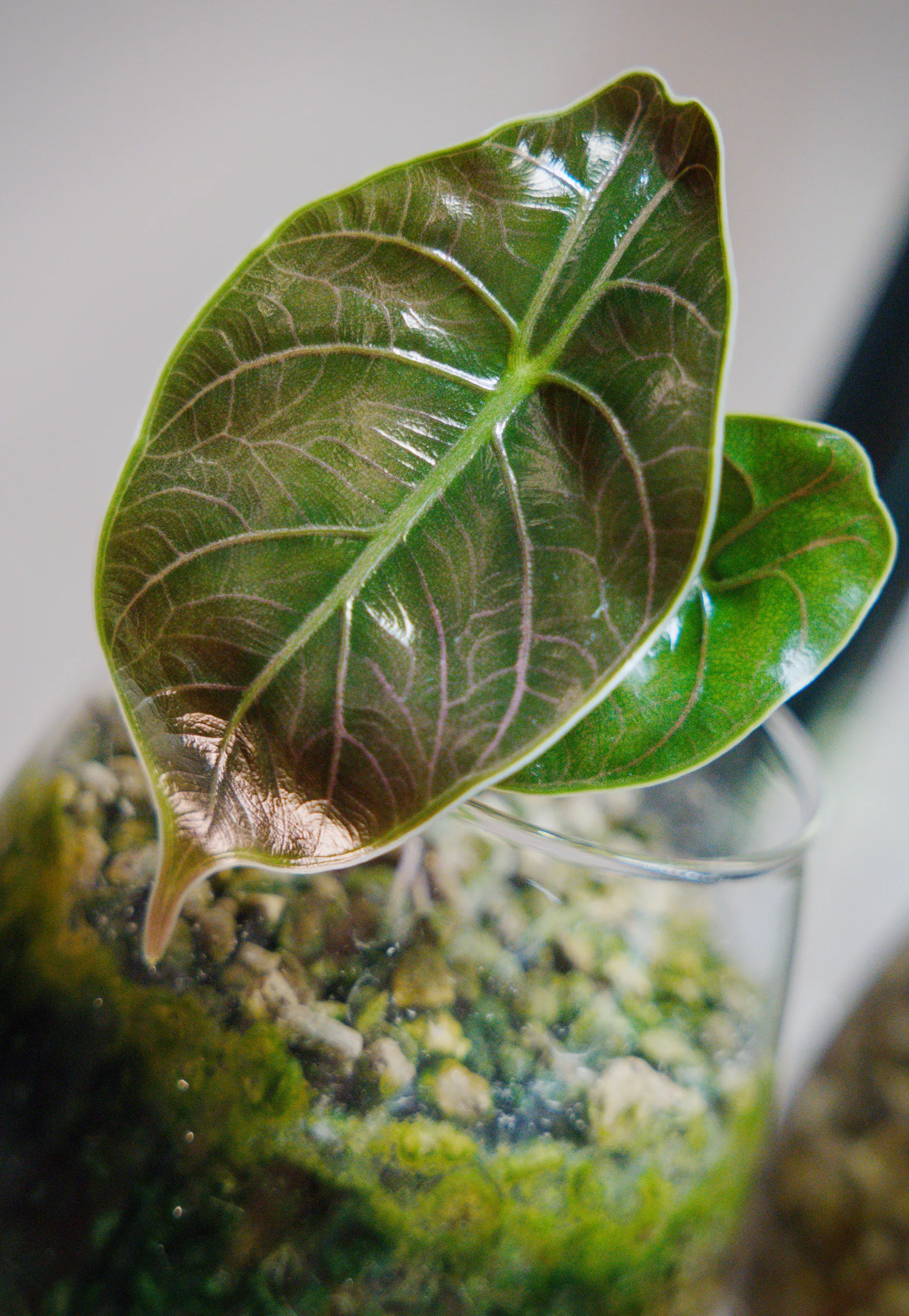
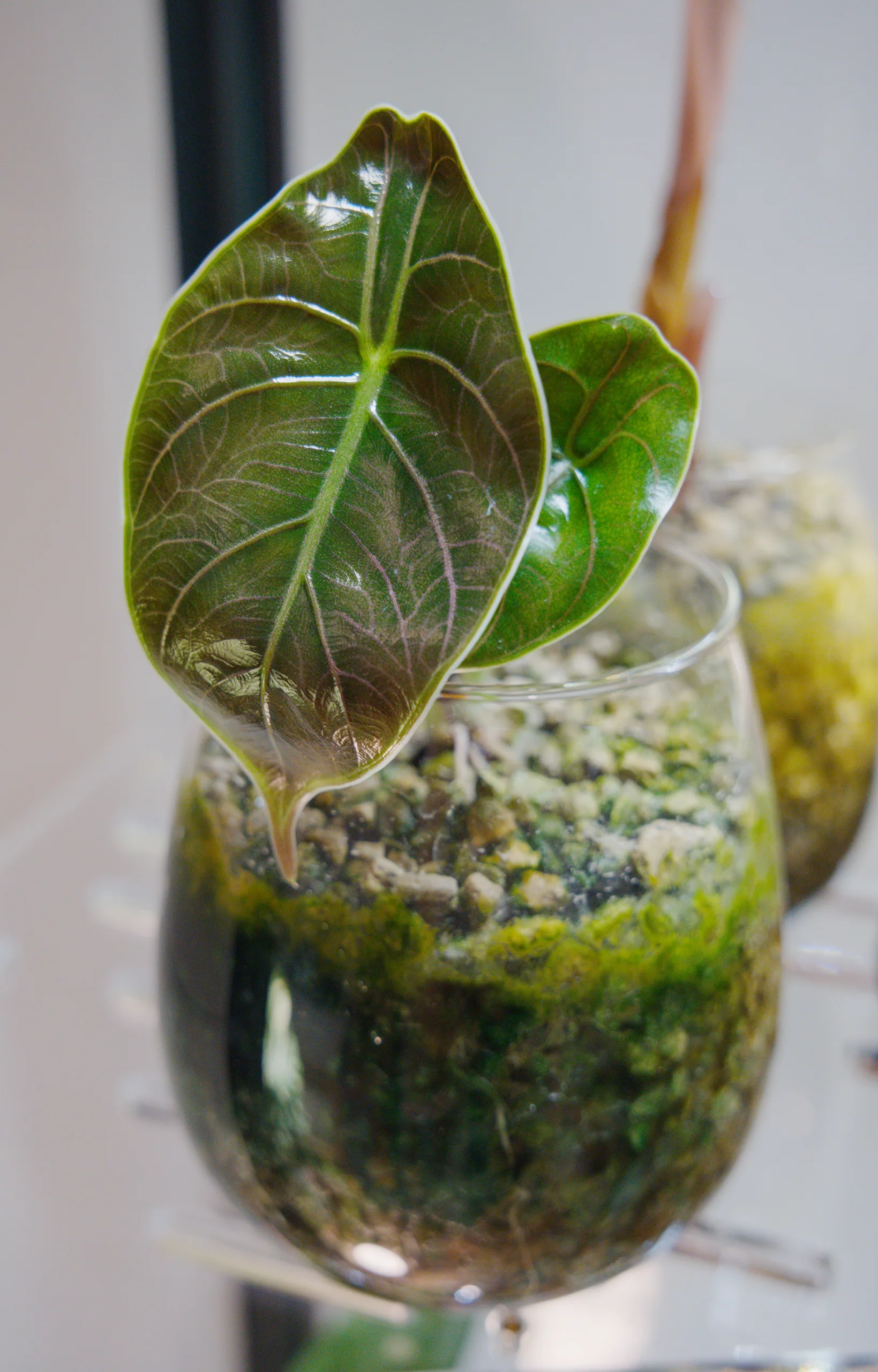
Blades run about 16–20 cm long and 8.5–11 cm wide, broadly ovate-elliptic — two specialist sources give the identical range, which is the signature of both copying the description.62 Height is less settled: the description-derived figure is 10–28 cm, while growers report up to 40 cm in a pot.9 On colour, the sober version is dark coppery purplish green above and pale green beneath. The trade promises crimson undersides and shifting violet; that is selling, and a plant that arrives merely dark is not a disappointment.
Fun facts
- It is not iridescent, and that is checkable. The word is everywhere in the listings, but structural colour — the interference effect that makes a beetle or a Selaginella blue — has never been demonstrated in any aroid. Glover and Whitney’s review of plant structural colour lists the documented cases and includes no Araceae;10 a 2024 survey that expanded the known photonic-helicoid taxa from five generagenusThe rank above species: a group of species close enough to share a name. Monstera and Philodendron are genera; the first word of a botanical name is the genus.Glossary to more than thirty-five still found none, and the one aroid it tested, a Bornean Bucephalandra, lacked them.11 What this leaf has is angle-dependent gloss on a very dark ground, which looks like the same thing and is not.
- The velvet is cell shape, and whether it helps is a live argument. Deep-shade tropical plants characteristically carry convex, lens-shaped outer epidermal walls, and the classic 1985 modelling study argued they focus light down into the leaf.12 Then somebody measured it: leaves with those cells absorbed 2–3 per cent less under diffuse light than under direct, and the authors concluded the lenses do not help capture diffuse light.13 Later reviews side with the measurement.14 The practical reading is that the lenses reward a directional beam rather than vague ambient brightness — which is an argument for a bright spot out of the sun, not a dim corner.
- The colour on top costs it growth, and there is a number. AnthocyaninanthocyaninThe pigment class behind red, purple and pink in leaves and flowers. A plant missing it entirely is green where it should be red, which is what an albino sundew or a green-stemmed philodendron is.Glossary on the upper surface sits above the chloroplastschloroplastThe compartment inside a plant cell that does photosynthesis. White leaf tissue has none that work, which is why it cannot pay its own way.Glossary and takes light they would otherwise use. In a chimeric aroid where green and red tissue could be compared on one plant, green photosynthesised 39 per cent faster at saturating light.15 Nobody has assayed the pigment in this species specifically, so take the mechanism as the family’s rather than as measured here. Either way, a slow plant is doing what it looks like it is doing.
- Three of the four dark jewels are younger than the iPhone. Kew accepts 91 species of Alocasia;16 A. infernalis was named in 2007,17 A. baginda in 2011,18 and this one in 2016. That a plant on a windowsill in a western city was unknown to science twelve years ago is the genusgenusThe rank above species: a group of species close enough to share a name. Monstera and Philodendron are genera; the first word of a botanical name is the genus.Glossary in one sentence. It is on that windowsill at all because it propagates in tissue culturetissue cultureGrowing plants from a few cells in sterile jars of nutrient gel. It is how a rare cultivar becomes a supermarket plant, and why prices for some of them collapse.Glossary — Costa Farms says so on its own page for it.19
Care
Plant care- Light
- Bright indirect, and more of it than most people give them. They will not tolerate direct midday sun, but too little light produces weak petioles that cannot hold the leaves up.
- Water
- Water once the top few centimetres have dried through the growing season, and cut back sharply in dormancy — overwatering a resting plant is the main route to rot. Never waterlogged, never bone dry.
- Humidity
- Medium to high. Dry air browns the leaves and, more reliably than anything else, brings spider mites.
- Temperature
- 64-84 °F (18-29 °C) in growth, and not below about 61 °F (16 °C) while growing. Winter floor 50 °F (10 °C): below that, or in cooler and drier conditions generally, they drop leaves and rest, which is normal rather than fatal.
- Substrate
- Airy but moisture-retentive — bark and perlite with enough coir or sphagnum that it does not dry out in a day.
- Fertilizer
- A balanced feed at half strength every third watering through spring and summer. Nothing at all once growth stops.
- Propagation
- Offsets and the small tubers that form on the rhizome, separated at repotting. They root in damp sphagnum in a closed container.
- Dormancy
- Expected in a cool, dark winter — though a plant kept warm and bright may stay evergreen. It drops leaves and rests on the rhizome. Keep the mix barely damp, stop feeding, and do not repot; most losses happen when a resting plant is treated as a sick one.
- Common problems
-
- Sudden leaf loss in autumn is usually dormancy, not death — check the rhizome before discarding anything
- Spider mites are the defining pest of this genus; inspect leaf undersides weekly in dry air
- Drooping petioles that do not recover after watering usually mean rot below the soil
- Guttation — water beading at the leaf edge — is normal and not a symptom
- Every part carries calcium oxalate crystals: painful if eaten, and an irritant to skin and eyes
These photographs also live in the gallery .