Alocasia baginda 'Dragon Scale'
Dragon Scale
- Family
- Araceae
- Native to
- Borneo (East Kalimantan)
- Habit
- Rhizomatous perennial
My plant
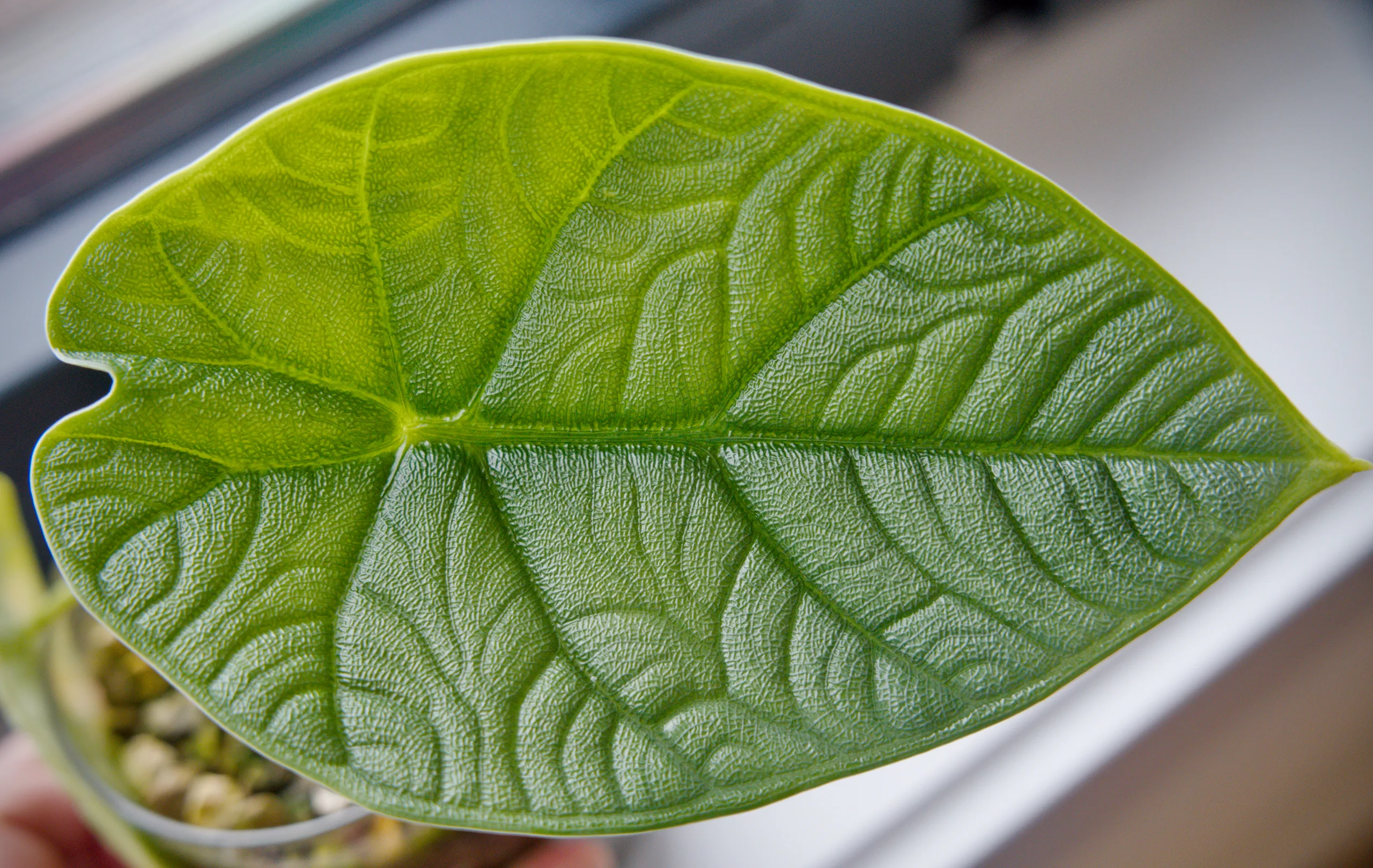
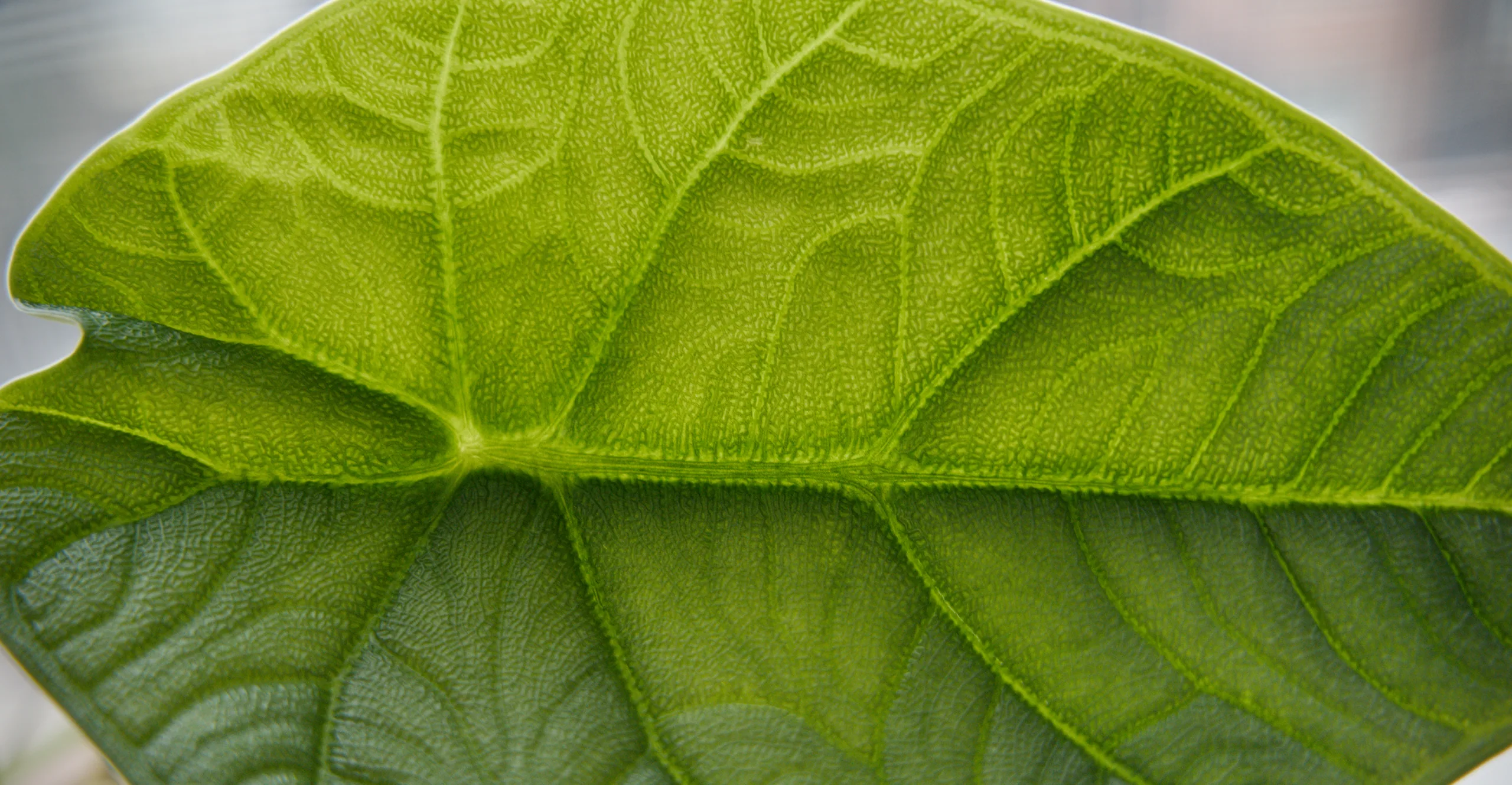
Where it comes from
Borneo, on the Indonesian side. Kew gives the range for Alocasia baginda as Kalimantan;1 the description narrows it to the east of that and no further, because the type’s label says “East Kalimantan, without exact locality”.2
The reason it says that is the interesting part: the plant science described was a cultivated one. The type is an accession from the Bali Botanic Garden, E20081015, with its wild provenance already lost by the time it was named.2 The species entered botany out of a nursery bed, which is why the record has a region and not a place.
Which brings us to the limestone. Nearly every listing says this is a karst plant and reasons from there to potting advice. Kew’s habitat field, reproducing the description, actually reads: “Unknown.” The authors then note that the species baginda most resembles are tied either to limestone or to ultramafic rock, and suggest searching those outcrops if anyone relocates it in the wild.3 That is a hypothesis, offered as one, about where to go looking — and it names two substrates that are chemically opposite. Limestone is calcareous and alkaline; ultramafics are magnesium-rich and often toxic to plants that are not adapted to them. A guess spanning both cannot tell you to lime your mix.
Naming and description
Alocasia baginda Kurniawan & P.C.Boyce, published 21 February 2011 in Acta Phytotaxonomica et Geobotanica 61(3): 123–126.12 No synonymssynonymA botanical name that is no longer the accepted one for a plant, usually because the same species was described twice. Old books and plant labels are full of them.Glossary. Baginda is a Bahasa Indonesia honorific — “King”, or “Majesty”.3 The genusgenusThe rank above species: a group of species close enough to share a name. Monstera and Philodendron are genera; the first word of a botanical name is the genus.Glossary has a habit of giving regal names to the plants with the best leaves, and this one keeps it.
‘Dragon Scale’ is a trade name rather than a registered cultivarcultivarA plant selected and propagated by people rather than described from the wild. Written in single quotes after the species — Monstera deliciosa 'Thai Constellation' — and never italicised.Glossary. The International Aroid Society is the international registration authority for Araceae4 and its registry has no entry for it.5 There is a nice piece of evidence of how little that matters in practice: when Alocasia ‘Dragon Wings’ was registered in November 2024, the registry recorded its seed parent as “Alocasia baginda ‘Dragon Scale’” — using the unregistered name in a formal record.6
The plant is smaller than its photographs suggest: 25–30 cm tall, blades 10–18 by 7–12 cm on petiolespetioleThe stalk that carries a leaf. Length, colour and texture often tell species apart when the leaves do not.Glossary of 13–23 cm.3 The blade is peltate — the stalk joins inside the margin rather than at a notch — and “stiffly and thickly coriaceous”, which is the texture people mean when they call it reptilian. The scale effect is architecture rather than pattern: the veins are sunk into the surface and the tissue between them bulges, so the light does the rest. Turn a leaf over for the diagnostic: pale green beneath, with the midrib and the primary and marginal veins in deep red.3
Against A. melo, the separation is in the description’s own diagnosis — baginda is smooth between the bullae and dark matte green, melo is finely and strongly rugose all over.3 Against ‘Silver Dragon’, same species, different selection: ‘Silver Dragon’ is pale overall with dark veins, ‘Dragon Scale’ dark overall with grey bullae. No botanical source separates ‘Dragon Scale’ from the plain species at all; the specialist reading is simply that it is the darker selection.7
Fun facts
- The limestone advice is built on a sentence that says “unknown”. It is worth seeing how the chain forms: the description guesses at limestone or ultramafics, a nursery drops the second half, and what arrives at the buyer is “add lime”. Nobody has seen this plant growing wild. The honest care conclusion from a habitat field reading “Unknown” is to copy what works for its relatives and watch the plant, which is what you were going to do anyway.
- Nobody has explained the leaf, either. The bullate surface with sunken veins is described in detail and accounted for nowhere — the lens-cell literature that explains velvety aroid leaves is about smooth surfaces on Anthurium and Begonia, and no study addresses bullate blades in the family. It is a striking piece of engineering with no published function, which is a more interesting thing to say than a guess.
- The RHSRHSThe Royal Horticultural Society. Its plant register and its Award of Garden Merit are among the few horticultural authorities worth citing.Glossary has the size wrong by a factor of five. Its listing for the sibling selection ‘Pink Dragon’ gives 1–1.5 m tall with arrow-shaped leaves and silvery-white veins.8 That describes a sagittate Alocasia, not a peltate bullate baginda, and it is four or five times the described plant’s 25–30 cm. Both of the RHSRHSThe Royal Horticultural Society. Its plant register and its Award of Garden Merit are among the few horticultural authorities worth citing.Glossary’s records for it carry an unresolved name status. Trust the description: this is a plant for a shelf, not a floor.
- It is not the other dragon. Alocasia heterophylla ‘Dragon’s Breath’ is Philippine, endemicendemicFound naturally in one place and nowhere else.Glossary to Luzon, Mindanao and Polillo, and grows in lowland dipterocarp forest to about 300 m — a documented habitat, unlike this one.9 Its leaves are narrowly arrow-shaped and explicitly not bullate. The names rhyme; the plants do not, and advice written for one is not advice for the other.
Care
Plant care- Light
- Bright indirect, and more of it than most people give them. They will not tolerate direct midday sun, but too little light produces weak petioles that cannot hold the leaves up.
- Water
- Water once the top few centimetres have dried through the growing season, and cut back sharply in dormancy — overwatering a resting plant is the main route to rot. Never waterlogged, never bone dry.
- Humidity
- Medium to high. Dry air browns the leaves and, more reliably than anything else, brings spider mites.
- Temperature
- 64-84 °F (18-29 °C) in growth, and not below about 61 °F (16 °C) while growing. Winter floor 50 °F (10 °C): below that, or in cooler and drier conditions generally, they drop leaves and rest, which is normal rather than fatal.
- Substrate
- Airy but moisture-retentive — bark and perlite with enough coir or sphagnum that it does not dry out in a day.
- Fertilizer
- A balanced feed at half strength every third watering through spring and summer. Nothing at all once growth stops.
- Propagation
- Offsets and the small tubers that form on the rhizome, separated at repotting. They root in damp sphagnum in a closed container.
- Dormancy
- Expected in a cool, dark winter — though a plant kept warm and bright may stay evergreen. It drops leaves and rests on the rhizome. Keep the mix barely damp, stop feeding, and do not repot; most losses happen when a resting plant is treated as a sick one.
- Common problems
-
- Sudden leaf loss in autumn is usually dormancy, not death — check the rhizome before discarding anything
- Spider mites are the defining pest of this genus; inspect leaf undersides weekly in dry air
- Drooping petioles that do not recover after watering usually mean rot below the soil
- Guttation — water beading at the leaf edge — is normal and not a symptom
- Every part carries calcium oxalate crystals: painful if eaten, and an irritant to skin and eyes
These photographs also live in the gallery .