Alocasia nebula
Nebula
- Family
- Araceae
- Native to
- Borneo, probably Sarawak
- Habit
- Rhizomatous perennial
My plant
Where it comes from
Borneo, probably Sarawak — and the hedge is Kew’s, not mine. The POWOPOWOPlants of the World Online, Kew's database of accepted plant names and native ranges. Where a scientific name on this site comes from unless another authority is named.Glossary record says “Borneo (Sarawak)” flatly,1 but IPNIIPNIThe International Plant Names Index. It records where and when a name was published, without ruling on whether it is the accepted one — that is POWO's job.Glossary, from the same institution and working from the description’s own data, prints it with a question mark: “Borneo (Sarawak)?”.2 When Kew’s two databases disagree about whether they know where a plant is from, the honest answer is the one with the question mark.
The reason for the doubt is that the plant science named was growing in a glasshouse. The type was collected on 30 April 1999 by Alistair Hay himself, from the living collections of the Royal Botanic Garden Sydney, accession 980858.2 A garden bed in New South Wales is the origin of record for a Bornean species — which tells you something about how this plant reached botany, and something about how thin the field data is.
The habitat, such as it is, is reported as rain-forest floor over limestone at low elevation.3 Take that as substance rather than as a quotation: it appears on one specialist page outside anything marked as the original description, and it is absent from Kew. The pattern itself is real enough in the genusgenusThe rank above species: a group of species close enough to share a name. Monstera and Philodendron are genera; the first word of a botanical name is the genus.Glossary — Bornean Alocasia do include a run of limestone specialists4 — but no wild collection of this one has ever been reported, so there is nothing to confirm it against.
Note what “over limestone” would mean if true: the plant sits in forest floor litter lying on the rock, not in it. Karst holds a thin soil that drains almost instantly into the stone beneath.5 That argues for an airy humus mix that never stays wet — the opposite of the “so add lime” conclusion the phrase usually gets.
Naming and description
Alocasia nebula A.Hay, published in Curtis’s Botanical Magazine 17: 16 (2000), with a colour plate.12 No synonymssynonymA botanical name that is no longer the accepted one for a plant, usually because the same species was described twice. Old books and plant labels are full of them.Glossary.
Nebula is mist, cloud, vapour — and it fits twice over. The leaf does look like something drifting; and the plant’s own origin was unclear from the start, which is exactly what a type specimen from a Sydney glasshouse and a question mark after “Sarawak” amount to. A specialist reference states the double meaning outright;3 I could not reach the description to confirm the words are Hay’s, so the pun is offered here as a reading rather than as a quotation.
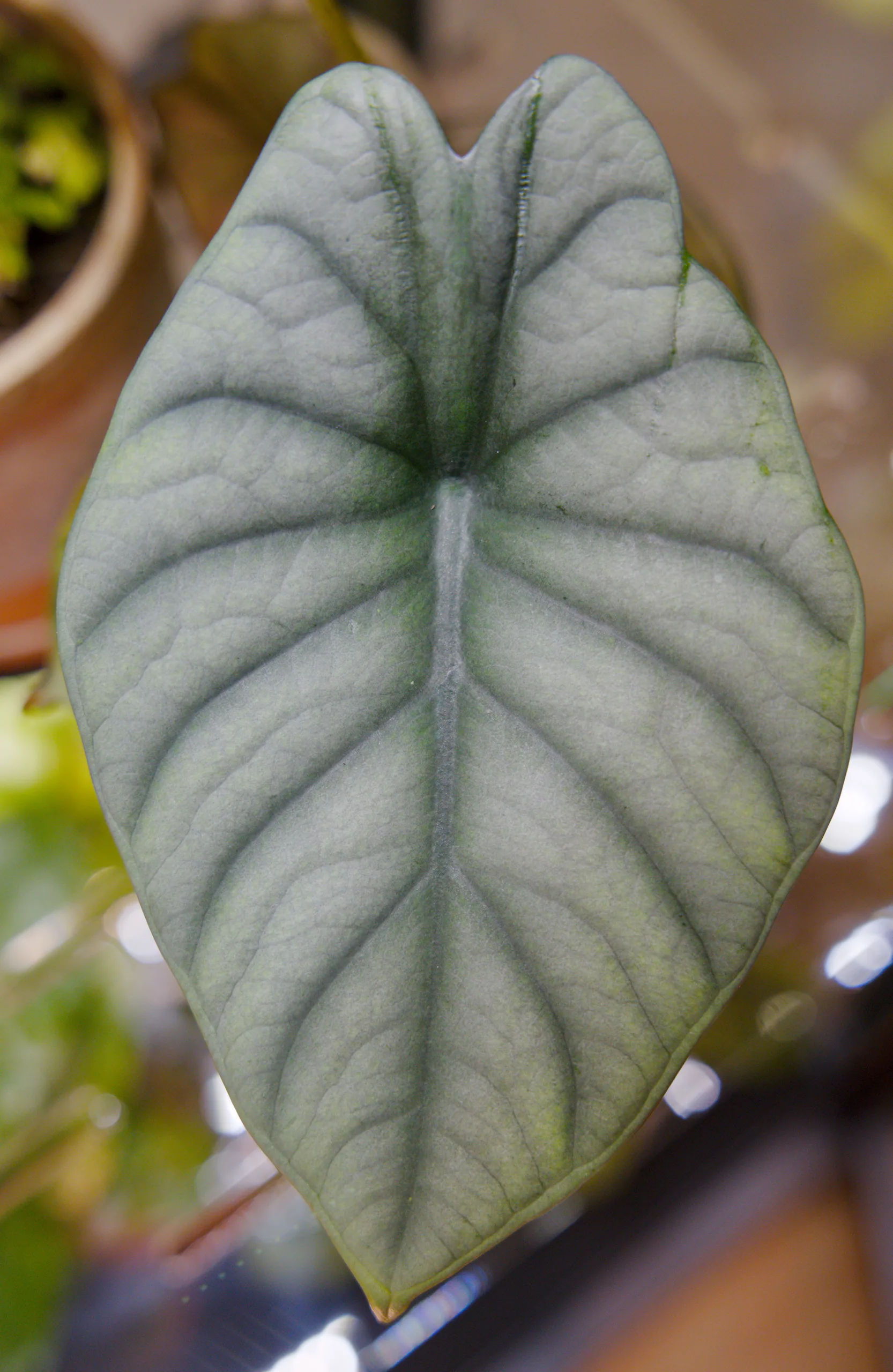
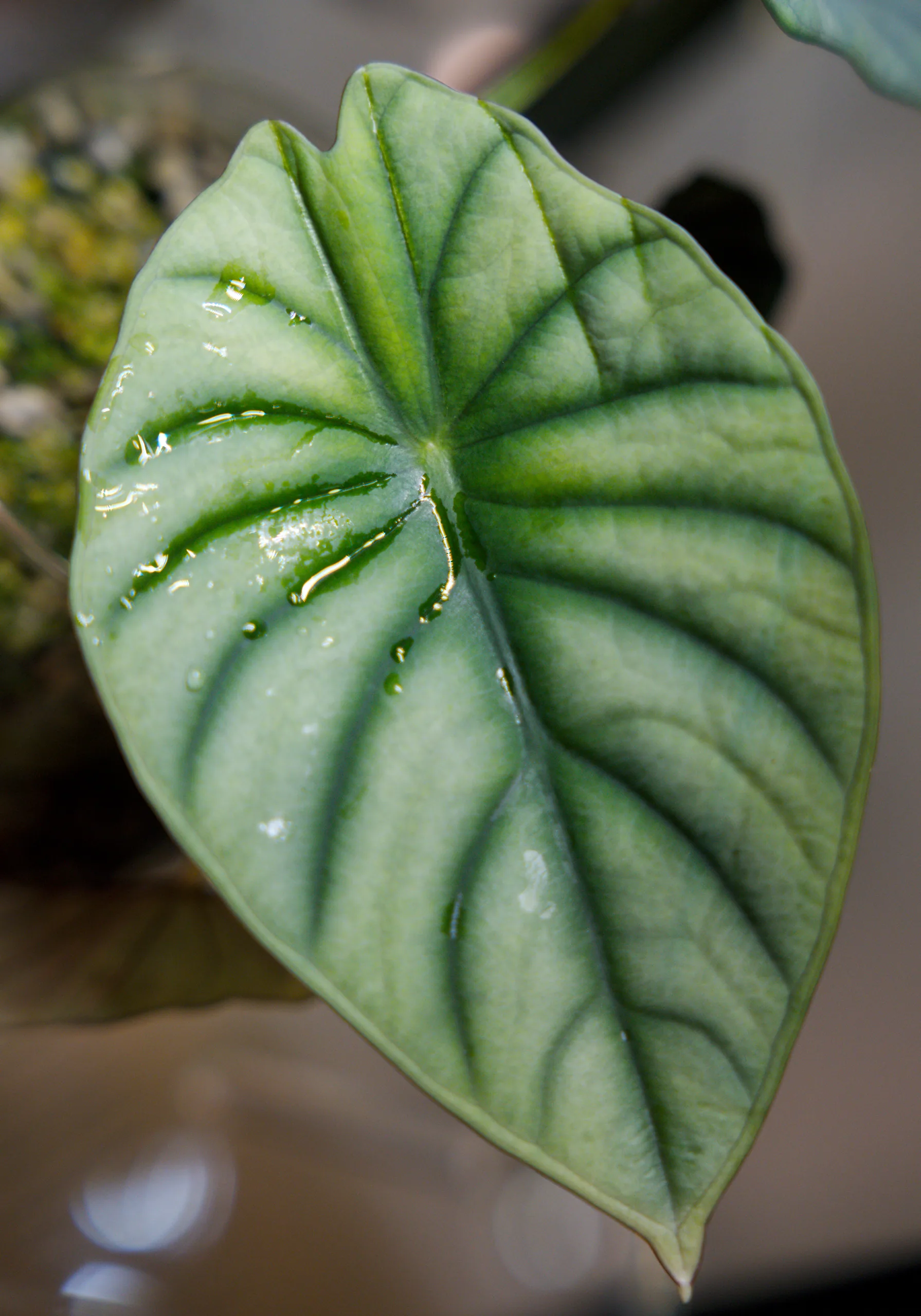
On colour, the trade oversells and the description undersells in the useful direction: the upper surface is matt grey green rather than blue or pewter, and the underside is dark reddish purple. The blade is strongly coriaceous and bullate between the veins, with 5–7 primary lateral veins each side and a conspicuous submarginal vein running about 2 mm inside the edge — that last one is visible without a lens and is the best single check on a label.3
It is small: a herb of about 20–30 cm carrying around six leaves, on petiolespetioleThe stalk that carries a leaf. Length, colour and texture often tell species apart when the leaves do not.Glossary of about 15 cm, with a blade roughly 23–24 cm long overall.3
Two names to be careful with. ‘Elaine’ is sold as a cultivarcultivarA plant selected and propagated by people rather than described from the wild. Written in single quotes after the species — Monstera deliciosa 'Thai Constellation' — and never italicised.Glossary of this species, but the specialist sources disagree about whether it belongs to nebula at all — one places it under Alocasia reginae, a separate accepted species6 — and another says flatly that plants sold as ‘Elaine’ or ‘Imperialis’ are simply A. nebula.37 ‘Imperialis’ is worse: it is a recycled botanical name that Kew places in the synonymy of Alocasia scabriuscula, a different species again.8
Fun facts
- The name is a joke about not knowing where it came from. Nebula for the clouded leaf, and for a plant whose provenance was a blank — a type gathered from a botanic garden bed, a range Kew’s own index queries, and not one reported wild collection in the twenty-five years since. It is the rare species epithetepithetThe second word of a botanical name — the deliciosa in Monstera deliciosa. It belongs to the species, and it never stands on its own.Glossary that documents the state of the evidence.
- Grey-blue leaves are usually wax over dark tissue, not pigment — and light changes them. The clean demonstration is on a cycad: the blue-grey comes from crystalline wax scattering over chlorophyll-rich tissue beneath.9 Alocasia leaves do carry measurable cuticular wax that does real work,10 and in Hosta the wax responsible fell from 47.1 to 9.1 mg·dm⁻² as light rose, so shade keeps the bloom and strong light burns it off.11 Two cautions: nobody has studied this species’ leaf surface, and Hay called it matt grey green rather than glaucous — so the bullate surface may be doing the work on its own. Testable at home, which is the point.
- The failure mode is named in the description. It has a reputation as the hardest Alocasia, and the single citation behind that is one grower’s opinion.1213 What is on the record is more specific and more useful: the plant is prone to sudden collapse, especially if the roots become too cool and waterlogged.3 Cold wet roots, not light and not feeding. That is an actionable sentence in a way that “difficult” is not.
Care
Plant care- Light
- Bright indirect, and more of it than most people give them. They will not tolerate direct midday sun, but too little light produces weak petioles that cannot hold the leaves up.
- Water
- Water once the top few centimetres have dried through the growing season, and cut back sharply in dormancy — overwatering a resting plant is the main route to rot. Never waterlogged, never bone dry.
- Humidity
- Medium to high. Dry air browns the leaves and, more reliably than anything else, brings spider mites.
- Temperature
- 64-84 °F (18-29 °C) in growth, and not below about 61 °F (16 °C) while growing. Winter floor 50 °F (10 °C): below that, or in cooler and drier conditions generally, they drop leaves and rest, which is normal rather than fatal.
- Substrate
- Airy but moisture-retentive — bark and perlite with enough coir or sphagnum that it does not dry out in a day.
- Fertilizer
- A balanced feed at half strength every third watering through spring and summer. Nothing at all once growth stops.
- Propagation
- Offsets and the small tubers that form on the rhizome, separated at repotting. They root in damp sphagnum in a closed container.
- Dormancy
- Expected in a cool, dark winter — though a plant kept warm and bright may stay evergreen. It drops leaves and rests on the rhizome. Keep the mix barely damp, stop feeding, and do not repot; most losses happen when a resting plant is treated as a sick one.
- Common problems
-
- Sudden leaf loss in autumn is usually dormancy, not death — check the rhizome before discarding anything
- Spider mites are the defining pest of this genus; inspect leaf undersides weekly in dry air
- Drooping petioles that do not recover after watering usually mean rot below the soil
- Guttation — water beading at the leaf edge — is normal and not a symptom
- Every part carries calcium oxalate crystals: painful if eaten, and an irritant to skin and eyes
These photographs also live in the gallery .