Apocynaceae
Hoya
Epiphytic climbers with thick waxy leaves and umbels of small, intensely scented, almost artificial-looking flowers. Pollen travels in paired sacs — pollinia, as in orchids — and in at least one species those sacs attach to the legs of night-flying moths. The family is Apocynaceae; sources still printing Asclepiadaceae are decades out of date.
Native to Tropical and subtropical Asia to Australia and the Pacific
Species
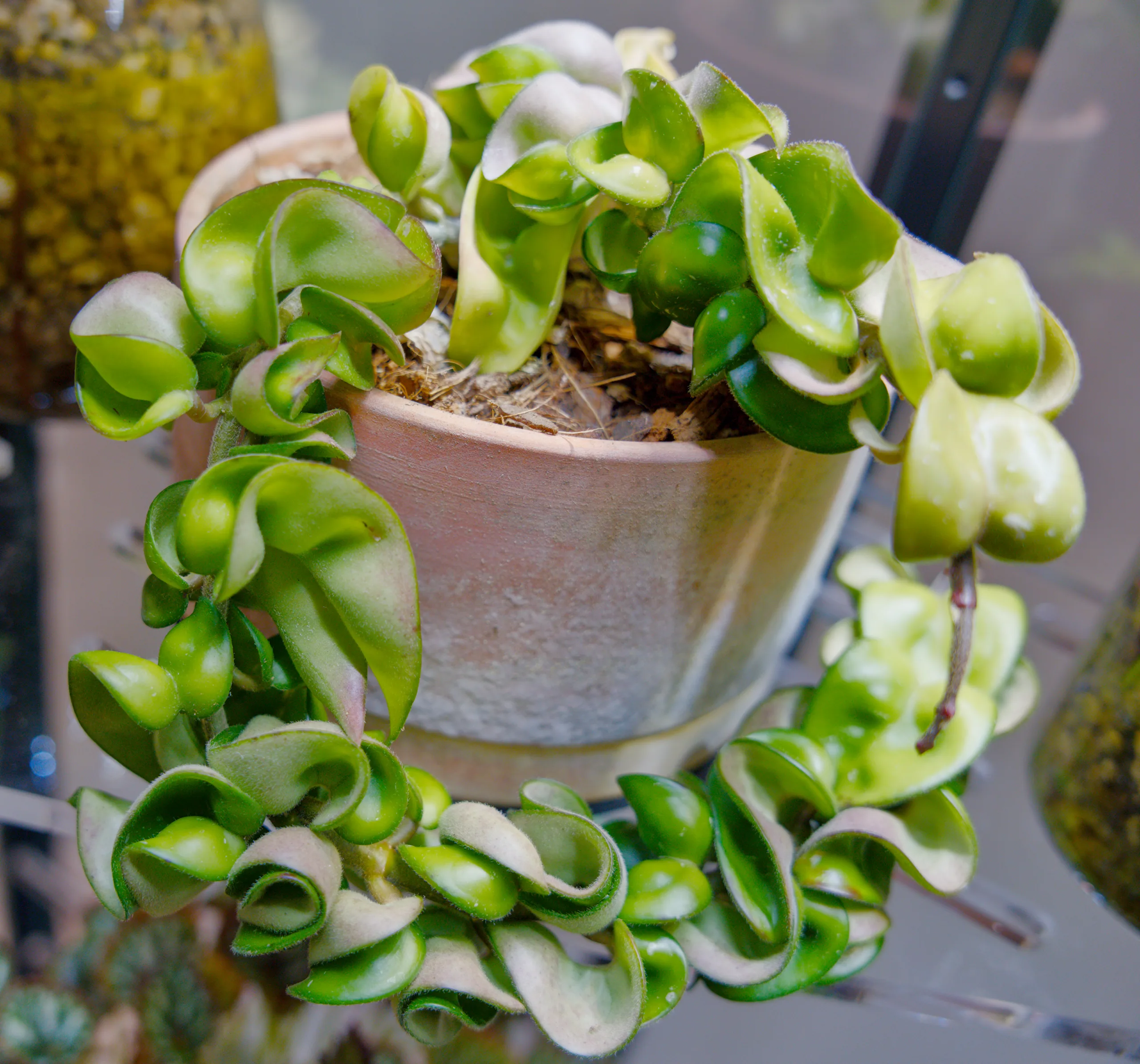
How Hoya generally wants to be treated
Species pages start from this and record only where they differ.
- Light
- Bright indirect, with some direct sun tolerated and often needed to flower. Too little light is the usual reason a hoya grows well and never blooms.
- Water
- Let the top of the mix dry before watering again. It is succulent-leaved and stores water, but it is not a desert plant — published work shows it takes up a good deal of carbon dioxide by day as well as by night, so it is not strictly CAM and should not be watered like a cactus.
- Humidity
- Moderate. It tolerates ordinary indoor air better than its reputation suggests.
- Temperature
- Warm, with a winter minimum of 50 °F (10 °C) — two of three sources give that figure and the third gives 45 °F (7 °C); take the higher one, since the cost of being wrong is cold damage.
- Substrate
- Very free-draining and coarse — an epiphyte mix of bark and perlite. It grows on trees, not in soil.
- Fertilizer
- A balanced feed at half strength through the growing season.
- Propagation
- Stem cuttings with at least one node, in a coarse mix or water.
- Dormancy
- None. Growth slows in winter with the light.
- Common problems
-
- Cutting off the old flower stalk. Do not: it flowers from the same peduncle again, and removing it removes next year's blooms
- No flowers at all, which is usually too little light
- Rot from a mix that holds water; it wants to dry between drinks
- Leaf drop below about 50 °F (10 °C)
- Mealybugs in the leaf axils, where they are easy to miss
In the collection
- Hoya compacta Hoya carnosa (L.f.) R.Br. 'Compacta'