Hoya carnosa (L.f.) R.Br. 'Compacta'
Hindu rope plant · Krinkle kurl · Wax plant
- Family
- Apocynaceae
- Native to
- Southern China, Japan, Taiwan and mainland South-East Asia
- Habit
- Epiphytic climber
- Also known as
- Hoya compacta C.M.Burton
My plant
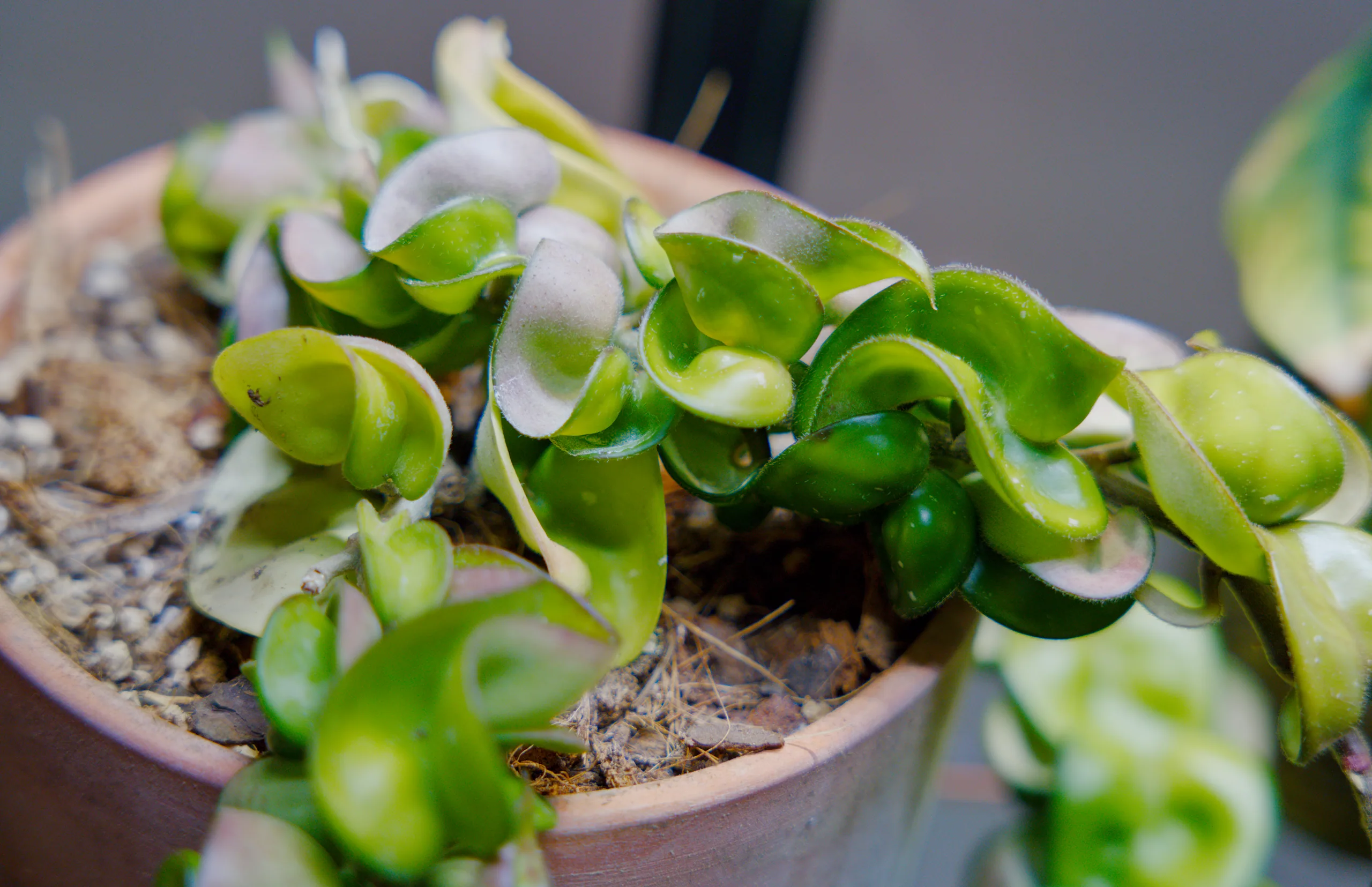
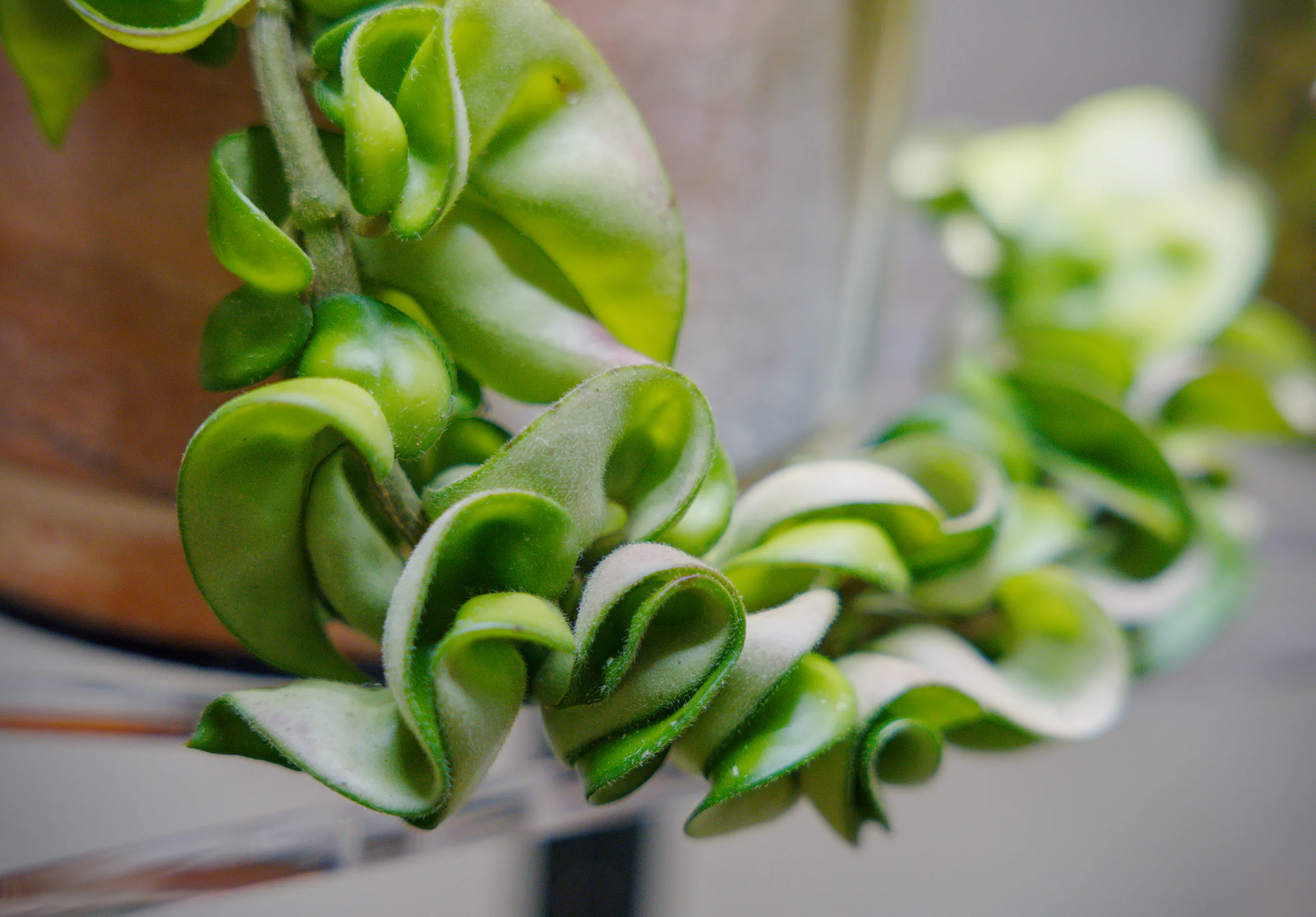
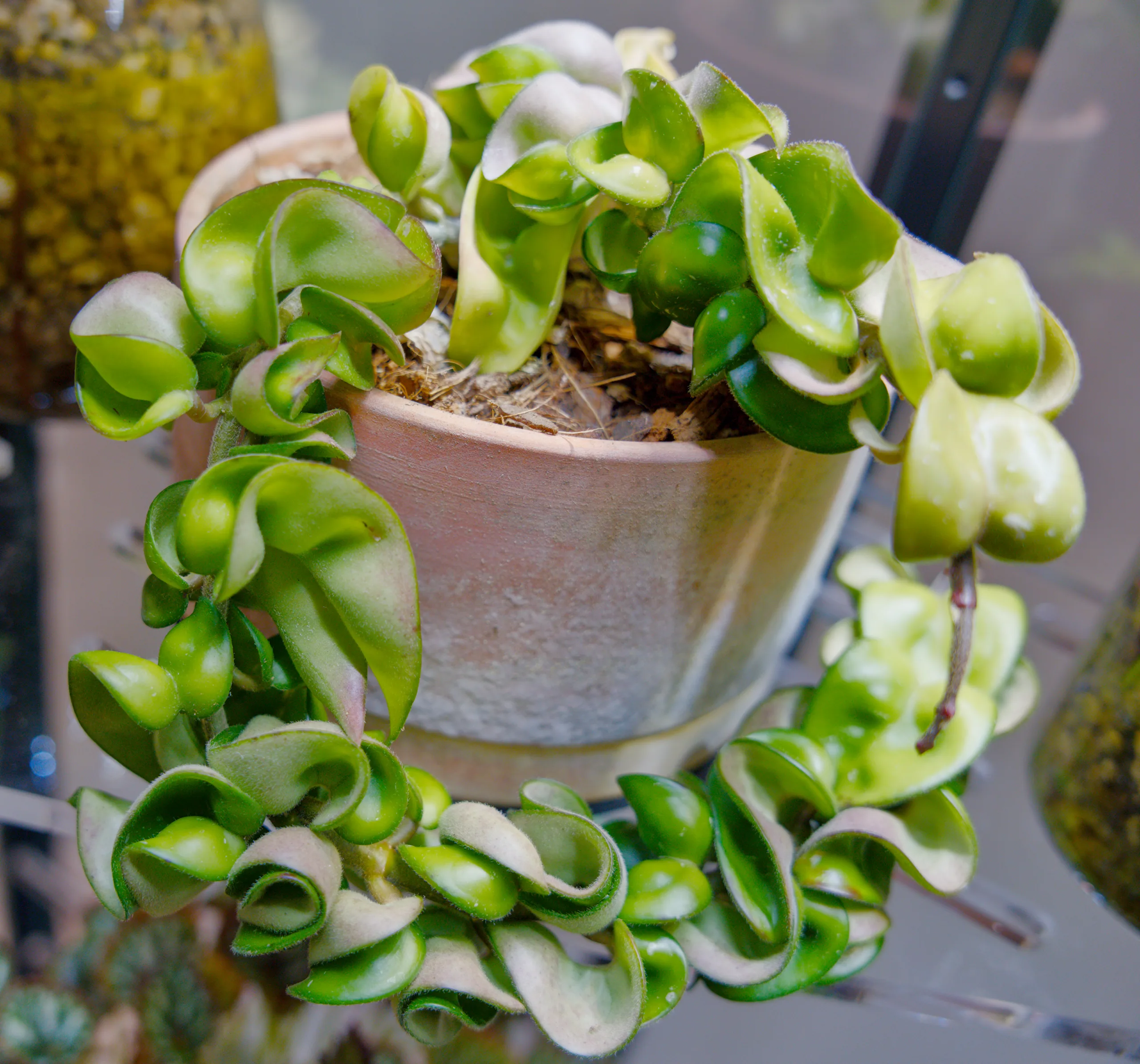
Where it comes from
Neither India nor Australia, despite being called the Hindu rope plant and despite Robert Brown publishing the name in a flora of New Holland. Kew gives the native range as south-central and south-east China, Hainan, Japan, Laos, Myanmar, Taiwan and the Nansei-shotō.1 Bangladesh, Fiji, Korea, the Solomons, Sumatra and Trinidad-Tobago are all introduced.
The family is Apocynaceae. NC State and both relevant ASPCA pages still print Asclepiadaceae, which has not been current for a long time.23
Naming and description
‘Compacta’ is unregistered and unpatented — and it could not be registered, since there is no International Cultivar Registration AuthorityICRAAn International Cultivar Registration Authority: the body that registers cultivar names for one group of plants. Most genera have none, which is why so many trade names are unregistered.Glossary for Hoya at all.45 It does have a botanical shadow, though: Hoya compacta C.M.Burton was published at species rank in 1990, and Kew sinks it as a heterotypic synonymsynonymA botanical name that is no longer the accepted one for a plant, usually because the same species was described twice. Old books and plant labels are full of them.Glossary of H. carnosa.61
What causes the twisted leaves is not documented anywhere. I would like to say it is a known mutation; nothing at any level of source explains it. The nearest thing is a US plant patentplant patentA US patent on a plant that can be reproduced without seed, lasting twenty years and barring propagation. Searching for one is how this site checks whether a cultivar's origin was ever documented.Glossary that describes the curled-leaf geometry precisely — six to ten dimples per leaf, folding along the long axis, margins curling upward — and confirms such forms arise as sportssportA shoot that appears on a plant carrying a mutation the rest does not have. Propagated on its own, it becomes a new cultivar.Glossary propagated by cuttings. But that patent is for ‘Krinkle 8 VariegatavariegationPatches of leaf with little or no chlorophyll, so they read as white, cream or yellow. The pale tissue cannot feed itself, which is why a variegated plant grows more slowly than a plain one.Glossary’, not ‘Compacta’, and the mutation it actually claims is the variegationvariegationPatches of leaf with little or no chlorophyll, so they read as white, cream or yellow. The pale tissue cannot feed itself, which is why a variegated plant grows more slowly than a plain one.Glossary rather than the curling.7 So: undocumented, rather than “a genetic mutation”.
Fun facts
- Never cut off the old flower stalk. This is the single most useful thing anyone can tell a hoya owner, and two independent sources say it: the stalk is a peduncle, and the plant uses it to produce its next round of blooms.8 The RHSRHSThe Royal Horticultural Society. Its plant register and its Award of Garden Merit are among the few horticultural authorities worth citing.Glossary puts it as an instruction — “resist the temptation to deadhead hoyas”, because more flowers often sprout from the stumps of previous clusters.9 Note the hedging in both: “often”, “may”. It reflowers from the same peduncle; it does not promise to do it annually.
- The scent peaks around midnight, on a clock rather than in response to anything. Nectar secretion in H. carnosa follows a circadian rhythm with maxima near midnight, and it free-runs at about 29 hours in constant conditions — so it is genuinely an internal clock, not a response to darkness.10
- Twenty-one years later, somebody found out who it was for. Work on hoya pollination found the pollinia attach to the legs of night-flying moths that settle on the flower, with the slippery corona giving them only restricted footholds.11 A midnight scent peak and a nocturnal moth, found independently and an archipelago apart.
- It is succulent but it is not a cactus, and the difference shows up in the watering. H. carnosa does use CAMCAMCrassulacean acid metabolism: opening the leaf pores at night, storing the carbon dioxide as acid, and running photosynthesis by day with the pores shut. It costs growth and saves water.Glossary — but published work finds substantial daytime carbon dioxide uptake as well, so it is not strictly CAMCAMCrassulacean acid metabolism: opening the leaf pores at night, storing the carbon dioxide as acid, and running photosynthesis by day with the pores shut. It costs growth and saves water.Glossary.12 Let it dry between waterings; do not treat it like a desert plant.
Care
- Light
- Bright indirect, with some direct sun tolerated and often needed to flower. Too little light is the usual reason a hoya grows well and never blooms.
- Water
- Let the top of the mix dry before watering again. It is succulent-leaved and stores water, but it is not a desert plant — published work shows it takes up a good deal of carbon dioxide by day as well as by night, so it is not strictly CAM and should not be watered like a cactus.
- Humidity
- Moderate. It tolerates ordinary indoor air better than its reputation suggests.
- Temperature
- Warm, with a winter minimum of 50 °F (10 °C) — two of three sources give that figure and the third gives 45 °F (7 °C); take the higher one, since the cost of being wrong is cold damage.
- Substrate
- Very free-draining and coarse — an epiphyte mix of bark and perlite. It grows on trees, not in soil.
- Fertilizer
- A balanced feed at half strength through the growing season.
- Propagation
- Stem cuttings with at least one node, in a coarse mix or water.
- Dormancy
- None. Growth slows in winter with the light.
- Common problems
-
- Cutting off the old flower stalk. Do not: it flowers from the same peduncle again, and removing it removes next year's blooms
- No flowers at all, which is usually too little light
- Rot from a mix that holds water; it wants to dry between drinks
- Leaf drop below about 50 °F (10 °C)
- Mealybugs in the leaf axils, where they are easy to miss
These photographs also live in the gallery .