Paphiopedilum Maudiae-type hybrid
Lady slipper orchid · Slipper orchid
- Family
- Orchidaceae
- Native to
- Nowhere — a garden hybrid
- Habit
- Terrestrial perennial
My plant
Where it comes from
The row above is not a formality. Every other page here answers it with a place; this one cannot, because the plant is a garden hybrid — no type specimen, no habitat, no wild population it was taken from. What it has instead is a genusgenusThe rank above species: a group of species close enough to share a name. Monstera and Philodendron are genera; the first word of a botanical name is the genus.Glossary and a nursery.
The genusgenusThe rank above species: a group of species close enough to share a name. Monstera and Philodendron are genera; the first word of a botanical name is the genus.Glossary is Asian. Kew gives the native range as southern China to tropical Asia,1 and the Missouri Botanical Garden gives the habit the herbarium records do not — mostly terrestrial, growing in leaf litter on the rainforest floor, some on rocky cliffs, occasionally up a tree.2
The nursery is not incidental, it is the law. The entire genusgenusThe rank above species: a group of species close enough to share a name. Monstera and Philodendron are genera; the first word of a botanical name is the genus.Glossary has been on CITES Appendix I since 1990.3 Kew’s own briefing puts the effect plainly: the listing “effectively prohibits the trade in wild-collected plants”, while allowing trade in artificially propagated ones under permit.4 So a slipper orchid on a shelf is a nursery plant, and it is a nursery plant because the alternative is illegal rather than because it is convenient.
The “Maudiae” in the name points at one specific cross. The Royal Horticultural Society is the international registration authority for orchid hybrids, and its register gives the grex Paphiopedilum Maudiae as P. callosum × P. lawrenceanum, registered by Charlesworth Ltd. in 1900.5 Everything since has borrowed the look.
Naming and description
The name stops at the genusgenusThe rank above species: a group of species close enough to share a name. Monstera and Philodendron are genera; the first word of a botanical name is the genus.Glossary, and the reason is worth more than the name would have been.
The genusgenusThe rank above species: a group of species close enough to share a name. Monstera and Philodendron are genera; the first word of a botanical name is the genus.Glossary is Paphiopedilum Pfitzer, published in Morphologische Studien über die Orchideenblüthe in 1886 and conserved against the older names it displaced — Kew lists three, all Rafinesque’s.16 The New York Botanical Garden gives the etymology: Paphos, the Cypriot city where Aphrodite came ashore, and Greek pedilon, a slipper.7
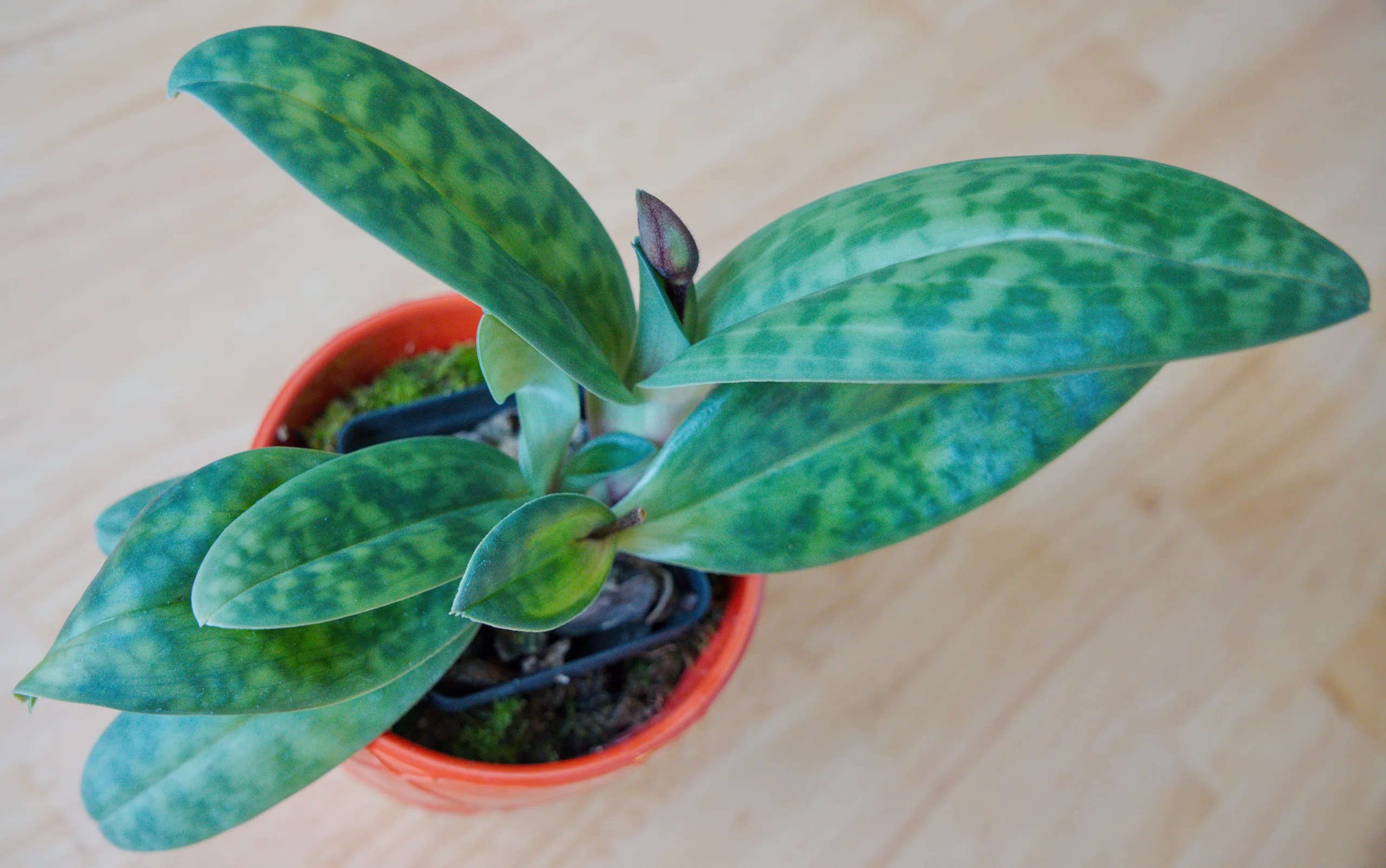
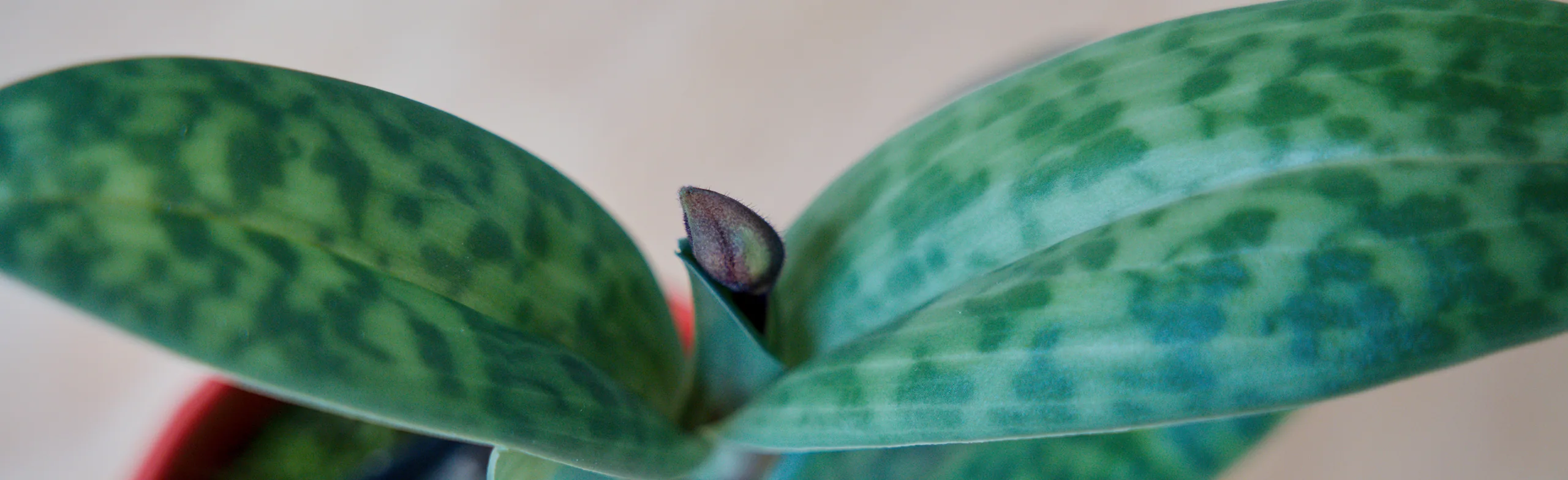
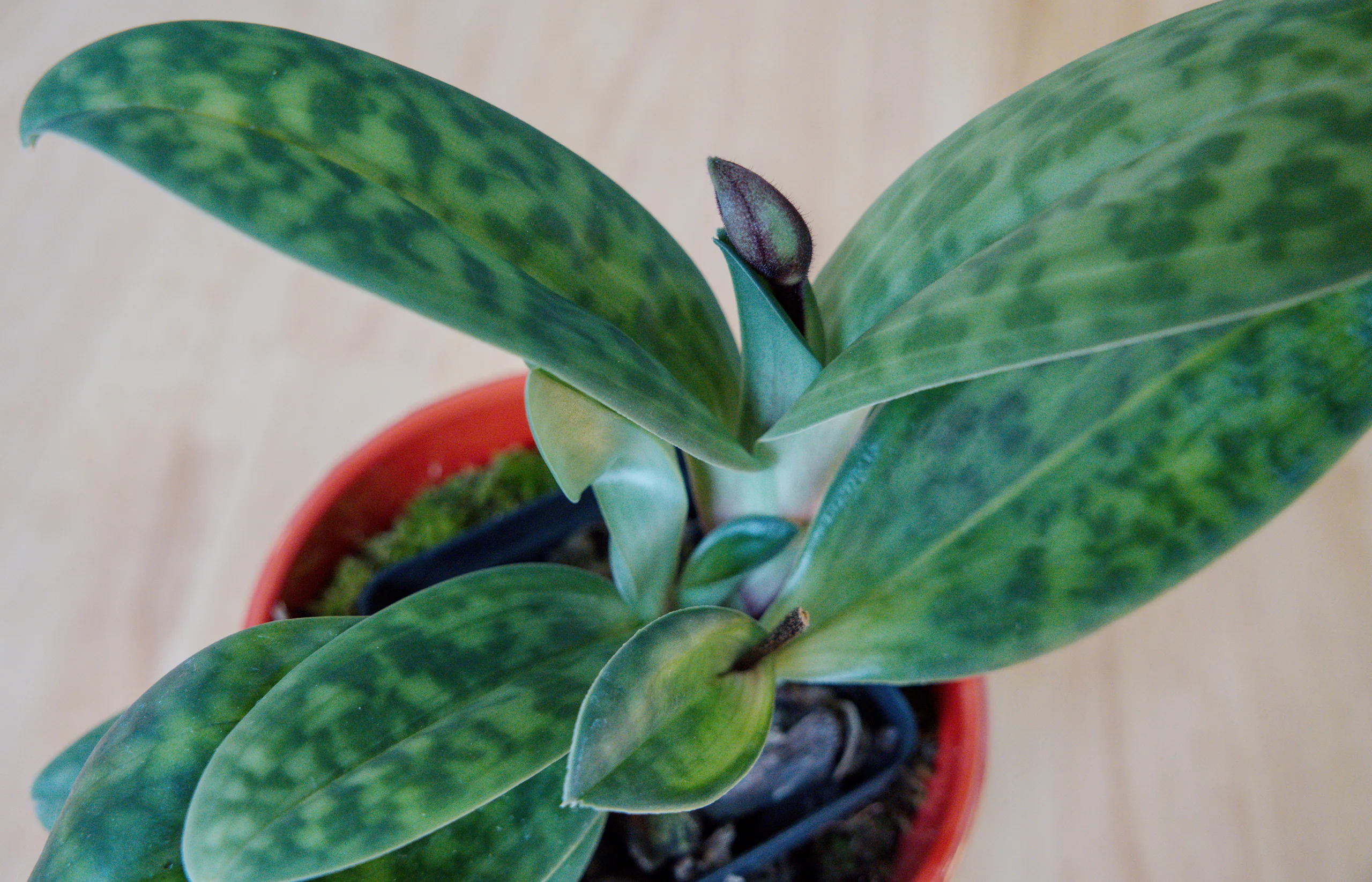
The tessellated leaves place it in section Barbata — (Kraenzl.) V.A.Albert & Börge Pett., Lindleyana 19948 — which is characterised by exactly that, a single flower over a tessellated leaf.9
It is not the plant the name “pink lady’s slipper” belongs to. In the United States that name means Cypripedium acaule: an eastern woodland species with two plain basal leaves and a pouch that opens through a slit down the front.10 Hardy, terrestrial, not a pot plant, and not this.
The flower rules out two of the obvious species and half-rules out a third. Not P. sukhakulii, whose dorsal sepal carries green lines and whose petals are bright green with brown-red dots; this one’s lines are magenta and its petal tips flush pink.11 Probably not straight P. callosum either, because the warts run over the whole petal blade rather than along the top edge — but that is where the evidence gets soft. The paper that supplies the character, a scanning-electron study of peninsular Malaysian species, distinguishes P. barbatum with “warts on upper or both margins and sometimes on the petals blades too” from P. callosum var. sublaeve with “warts on upper margin only”, and then says in the same breath that these traditional characters are “inconspicuous without a definite boundary”.12 The people who use the character professionally went to an electron microscope instead.
What none of it can do is name the grex, and that is a limit of the naming system rather than of the photograph. A grex is defined by parentage, not appearance: every seedling from one cross carries the name, siblings can look quite unlike each other, and plants from different crosses can match.13 So there is no route from a flower back to a grex. Worse — or more honestly, better, since it settles the question — the grex may not exist to be found. Specialist nurseries sell these as “Maudiae type” without one: as seed-grown plants “from a variety of hybrid crosses” where “each plant is one of a kind”,14 and one listing gives its plant’s parentage as a formula with the parents marked unregistered.15 A seedling of an unregistered cross has no grex name anywhere to recover.
That is why the page says “Maudiae type” and stops. It is trade vocabulary for a look, not a botanical rank, and it is not written in the form reserved for a registered group.
The colour is a trade term too, and a useful one. The original cross was made between albinistic parents and gives white dorsal sepals veined green with a green pouch; crossing an albino back to a normally coloured parent gives the coloratum forms; the wine-red vinicolors came later, out of dark red callosum found in the 1960s.16 White dorsal striped magenta, dark maroon pouch: this is a coloratum.
Fun facts
- The mottled leaves are a care instruction, and they are not a family tree. Three independent sources state the fork with numbers that agree: the American Orchid Society splits the genusgenusThe rank above species: a group of species close enough to share a name. Monstera and Philodendron are genera; the first word of a botanical name is the genus.Glossary into mottled-leaf warm growers, green-leaf cool growers and strap-leaved multiflorals that are warm again;17 the RHSRHSThe Royal Horticultural Society. Its plant register and its Award of Garden Merit are among the few horticultural authorities worth citing.Glossary gives the mottled group a night minimum of 65 °F (18 °C) against 50-77 °F (10-25 °C) for the plain green ones;18 the Missouri Botanical Garden gives much the same split in its own figures.2 And yet a 2025 phylogenomic revision found leaf colouration turning up “across unrelated groups” — it tracks where a plant grows, not what it is related to.19 Which is precisely why it works as a care rule and fails as a taxonomic one. A character that answers to the environment is the one you want when the question is what the plant wants.
- The character everyone identifies these by is one the specialists gave up on. Petal warts — where they sit, how many — is the line every key and every forum thread runs on. The Malaysian study above needed scanning electron microscopy of the flower surface to separate two species that had been separated on warts for a century, and it is explicit that it went there because the older characters had no definite boundary to draw.12 Any identification from a photograph, including the one on this page, is bounded by that.
- The flask exemption has a hole in it, and Kew is the one pointing at it. Seedlings and tissue cultures raised in vitro and moved in sterile containers are exempt from CITES controls that otherwise apply to an Appendix I plant — but only where the parent stock was legally obtained, and Kew warns in the same document that the exemption has been used to legitimise material taken from the wild.4 The definition of “artificially propagated” is the other half of that fence: CITES wants two or more generations, which is why a newly described species takes years to appear legally in cultivation at all.3
Care
- Light
- Bright and shaded rather than bright and direct — 10,750 to 21,500 lux, which the American Orchid Society also puts as two to three hours of shaded sun a day. An east, north or west window suits it. The RHS shades it through summer and moves it into unshaded light for the winter.
- Water
- Keep the mix moist and never sopping. There is no dry rest in this genus: ease off through winter with the light, but do not let the bark dry right out. Water at the pot rather than over the plant — the RHS says to avoid overhead watering and wetting the leaves.
- Humidity
- 40 to 50 per cent is the floor, with air movement whenever it is higher; the mottled-leaved types want more than that. Do not mist. Stand the pot on a tray of damp pebbles instead, clear of the water.
- Temperature
- 68-86 °F (20-30 °C) by day and not below 65 °F (18 °C) at night — this is the warm half of the genus. The Missouri Botanical Garden allows nights down to 60 °F (16 °C), so treat 65 °F (18 °C) as the safe floor rather than a cliff. The plain green cool-growing types want 50-77 °F (10-25 °C) and a winter minimum near 50 °F (10 °C); do not borrow their numbers for a mottled-leaved plant.
- Substrate
- Medium or fine fir bark with perlite, coarse sand or sphagnum — an orchid mix, not compost. Pot small, just large enough for the roots.
- Fertilizer
- A weak balanced feed, 5-5-5 to 10-10-10, regularly and year round, or a proprietary orchid feed every two to three weeks at the packet rate, eased off in winter. Flush the pot through with rain or distilled water every month or two: bark plus regular feeding accumulates salts, and the roots are what pay for it.
- Propagation
- Division after flowering — separate an offshoot that has roots of its own from a large clump. That is the only method the RHS gives; there is no leaf cutting here.
- Dormancy
- None described by any of the culture sheets. It grows year round, and watering and feeding ease off through winter with the light rather than stopping.
- Common problems
-
- Cold, for a mottled-leaved plant given a green-leaved plant's winter numbers — the single most common way to lose one
- Salt building up in the bark from regular feeding; flush the pot through with rain or distilled water
- Water sitting on the leaves or in the crown. The RHS says not to mist and not to water overhead
- Letting the mix dry right out, on the assumption that an orchid wants it
- Repotting on the plant's schedule rather than the bark's. Repot about every two years, when the medium breaks down and not when the pot looks full, and do it after flowering
These photographs also live in the gallery .