Philodendron 'Florida Ghost'
Florida Ghost
- Family
- Araceae
- Native to
- Mexico to tropical America and the Caribbean
- Habit
- Climber
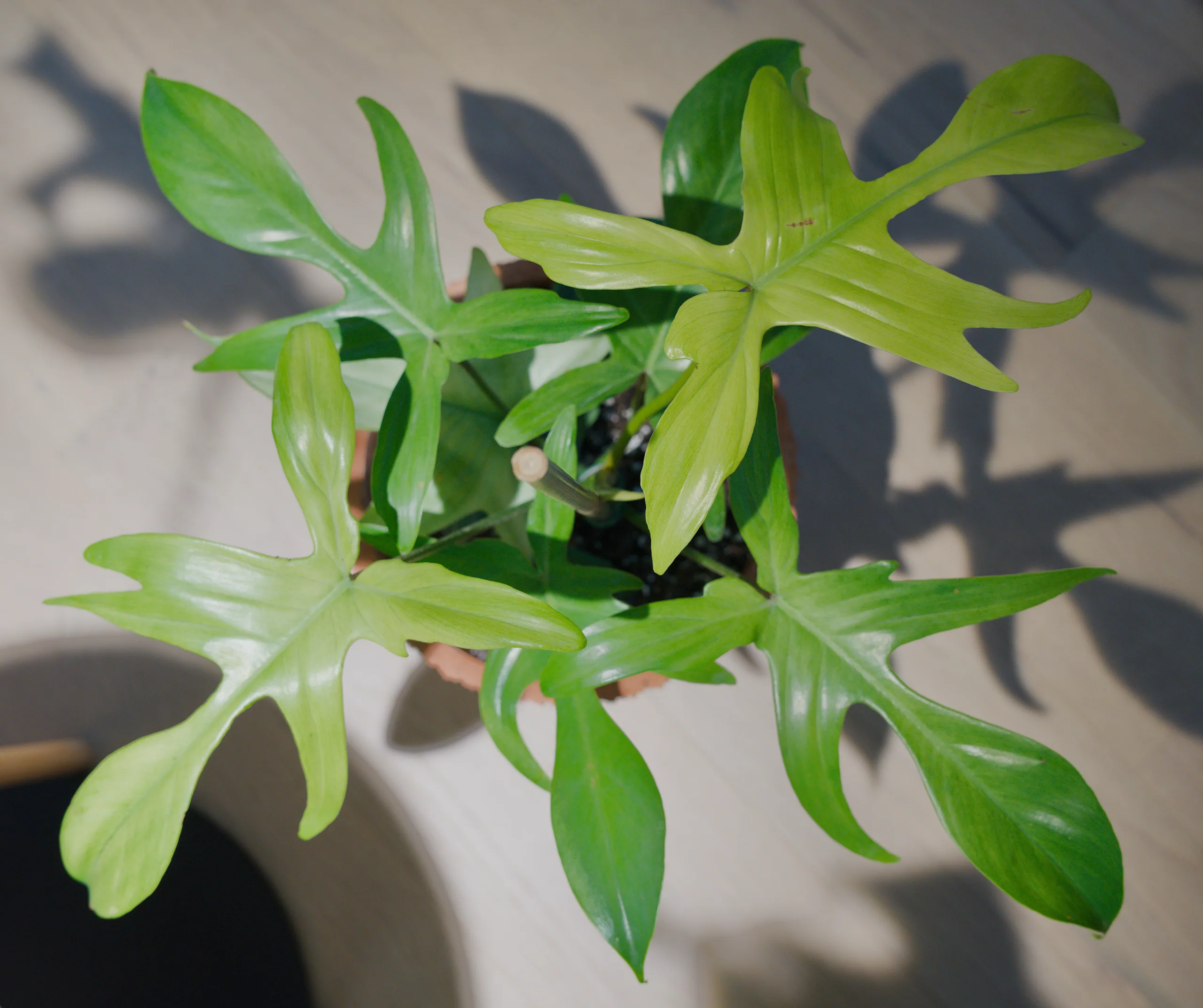
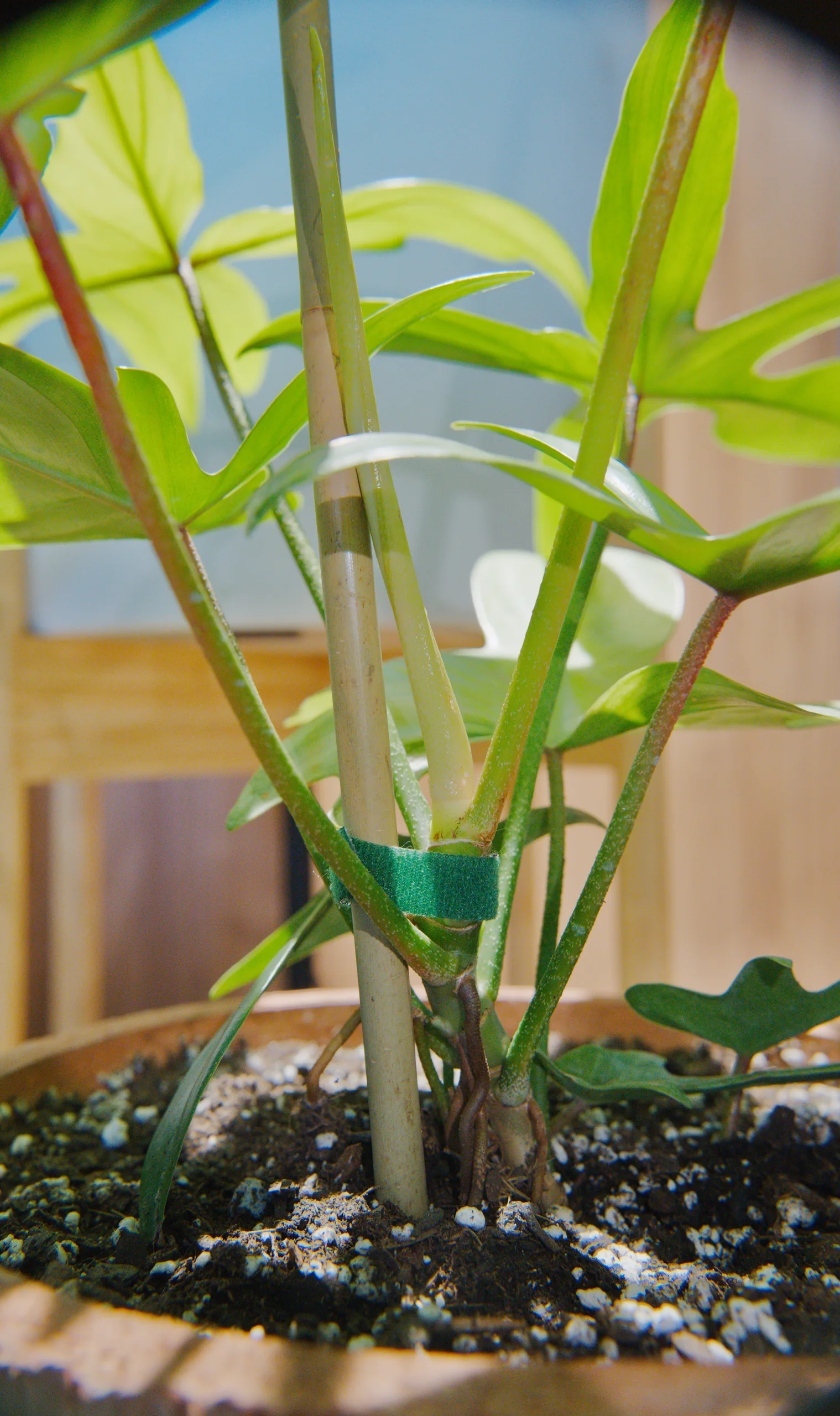
My plant
Where it comes from
A hybrid with parents rather than a range. Both species behind the ‘Florida’ line are well documented — Kew accepts Philodendron pedatum, from across northern and central South America, and Philodendron squamiferum, from French Guiana, Suriname and northern Brazil12 — but the cross itself is not.
The usual account is that ‘Florida’ came out of Robert McColley’s breeding programme at Bamboo Nursery in Apopka, Florida, as P. squamiferum × P. pedatum. The programme itself is documented: it ran from the 1960s and produced several familiar self-headingself-headingA philodendron that grows as a crown of leaves from a short upright stem rather than climbing. The opposite habit to a vining one.Glossary hybrids, and it appears in a plant patentplant patentA US patent on a plant that can be reproduced without seed, lasting twenty years and barring propagation. Searching for one is how this site checks whether a cultivar's origin was ever documented.Glossary and a horticultural review.34 Neither document mentions ‘Florida’ or that cross, though; the attribution lives in nursery and forum sources, and one long-time aroid grower doubts the parentage outright.5 Whether P. laciniatum — now a synonymsynonymA botanical name that is no longer the accepted one for a plant, usually because the same species was described twice. Old books and plant labels are full of them.Glossary of P. pedatum6 — was involved under its old name is one of the details nobody can settle.
‘Florida Ghost’ is a sportsportA shoot that appears on a plant carrying a mutation the rest does not have. Propagated on its own, it becomes a new cultivar.Glossary of ‘Florida’ — a mutation found on that hybrid and propagated for what its new leaves do — rather than a separate cross.7
Naming and description
The ‘Florida’ cultivarscultivarA plant selected and propagated by people rather than described from the wild. Written in single quotes after the species — Monstera deliciosa 'Thai Constellation' — and never italicised.Glossary are a cluster rather than a family tree: ‘Florida Ghost’, ‘Florida Beauty’ and ‘Florida Bronze’ share a look and a climbing, lobed-leaf habit, and are grouped by what they resemble more than by any confirmed pedigree. Reading them as siblings with a known parent is reading more into the names than the records support.
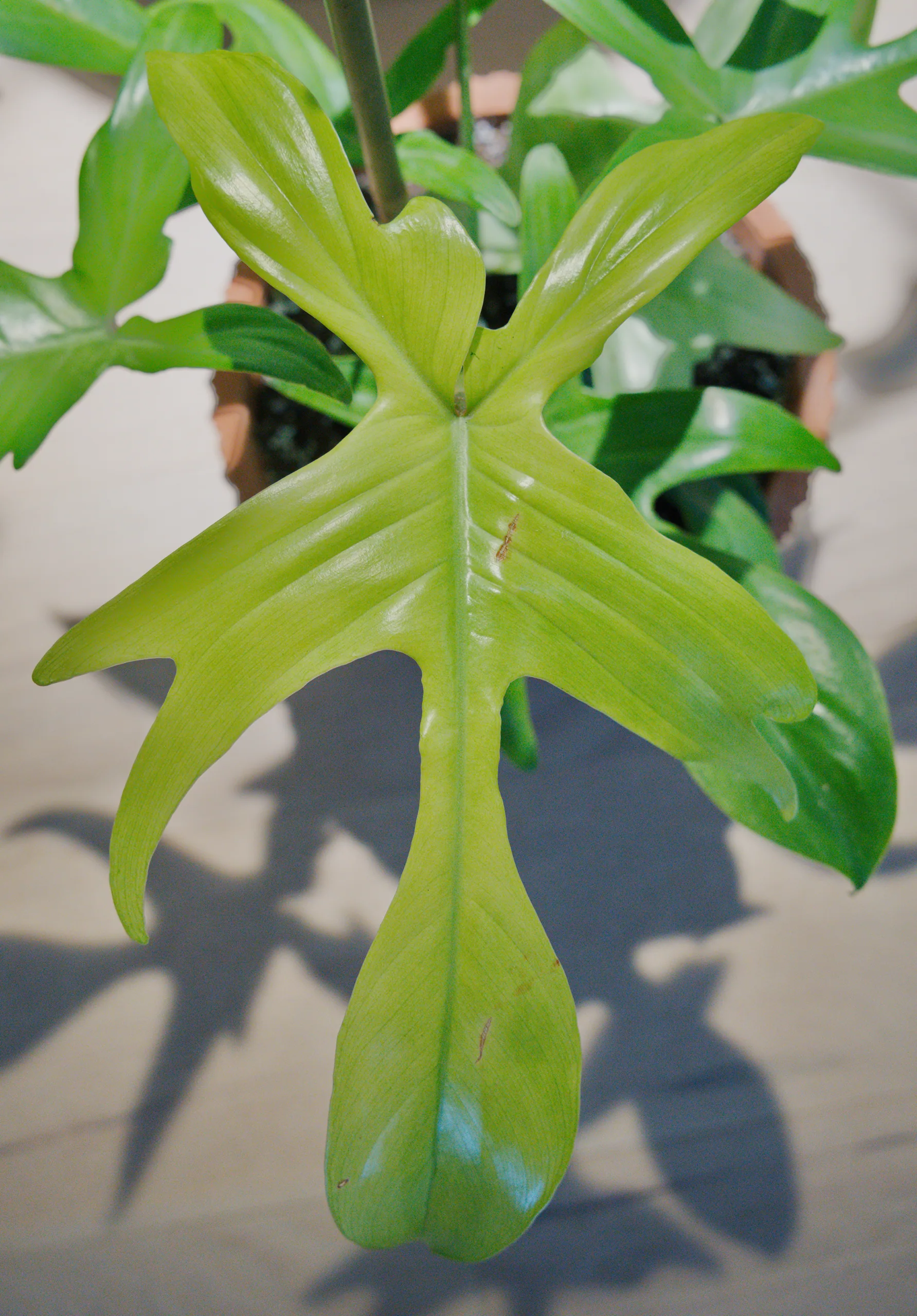
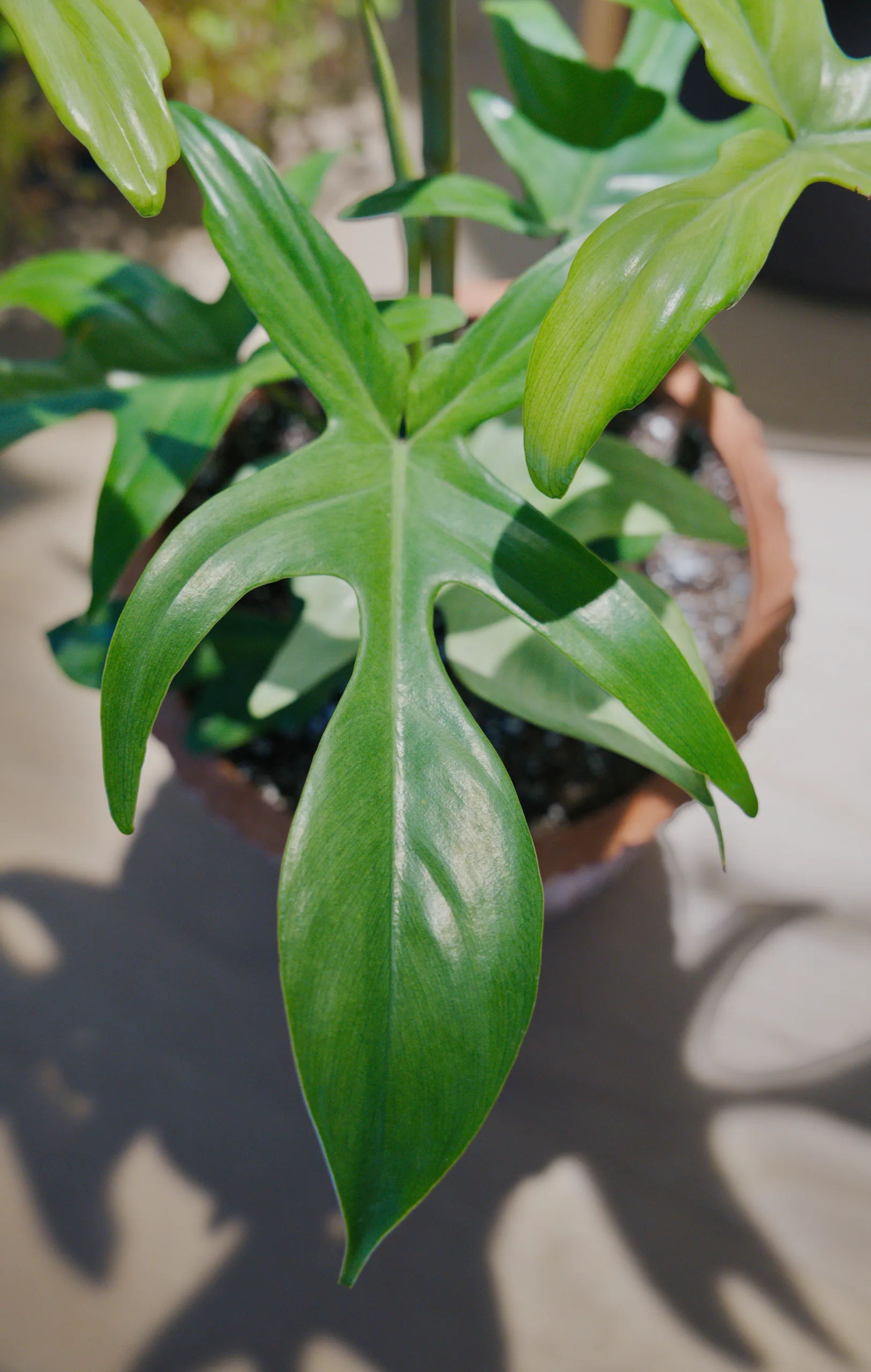
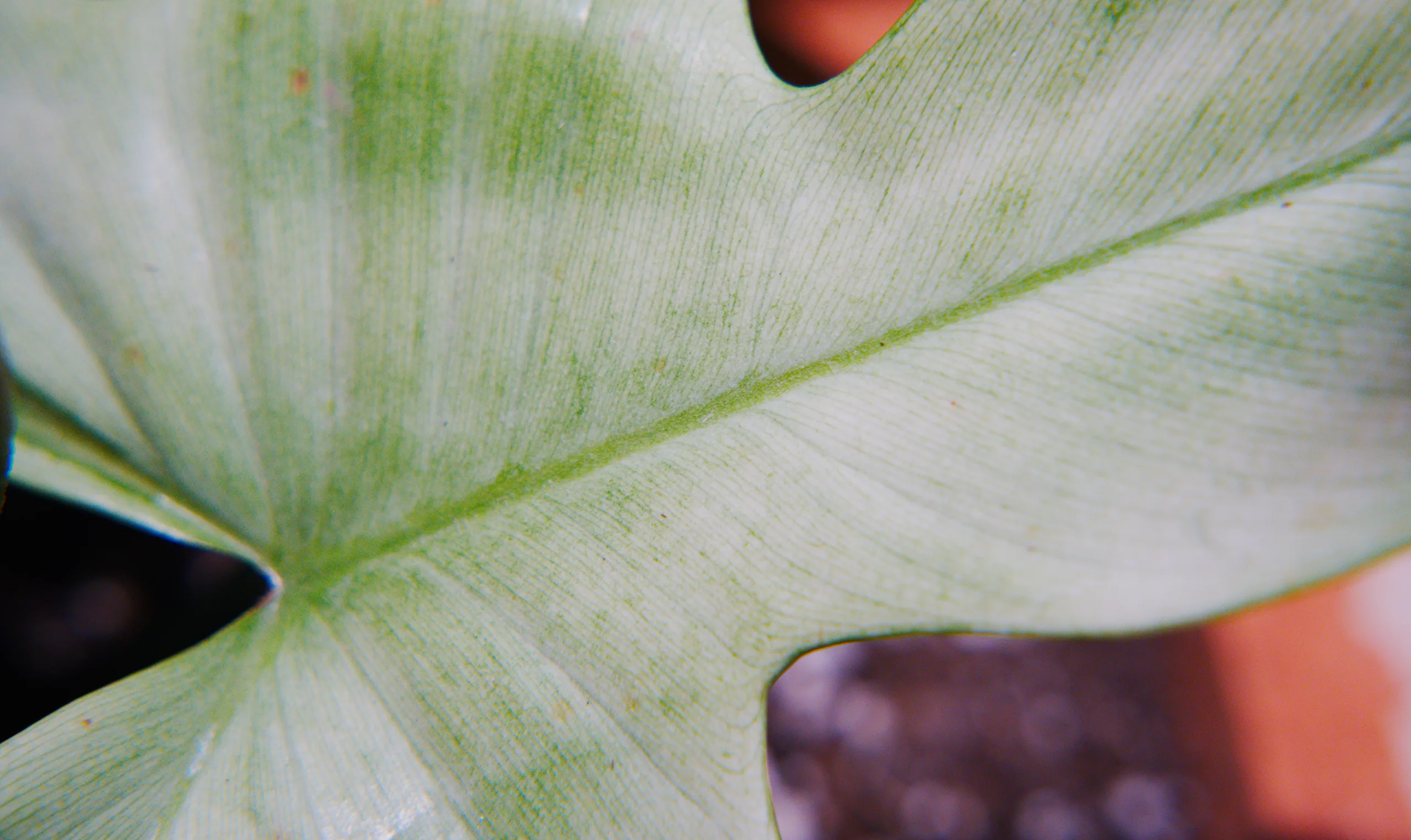
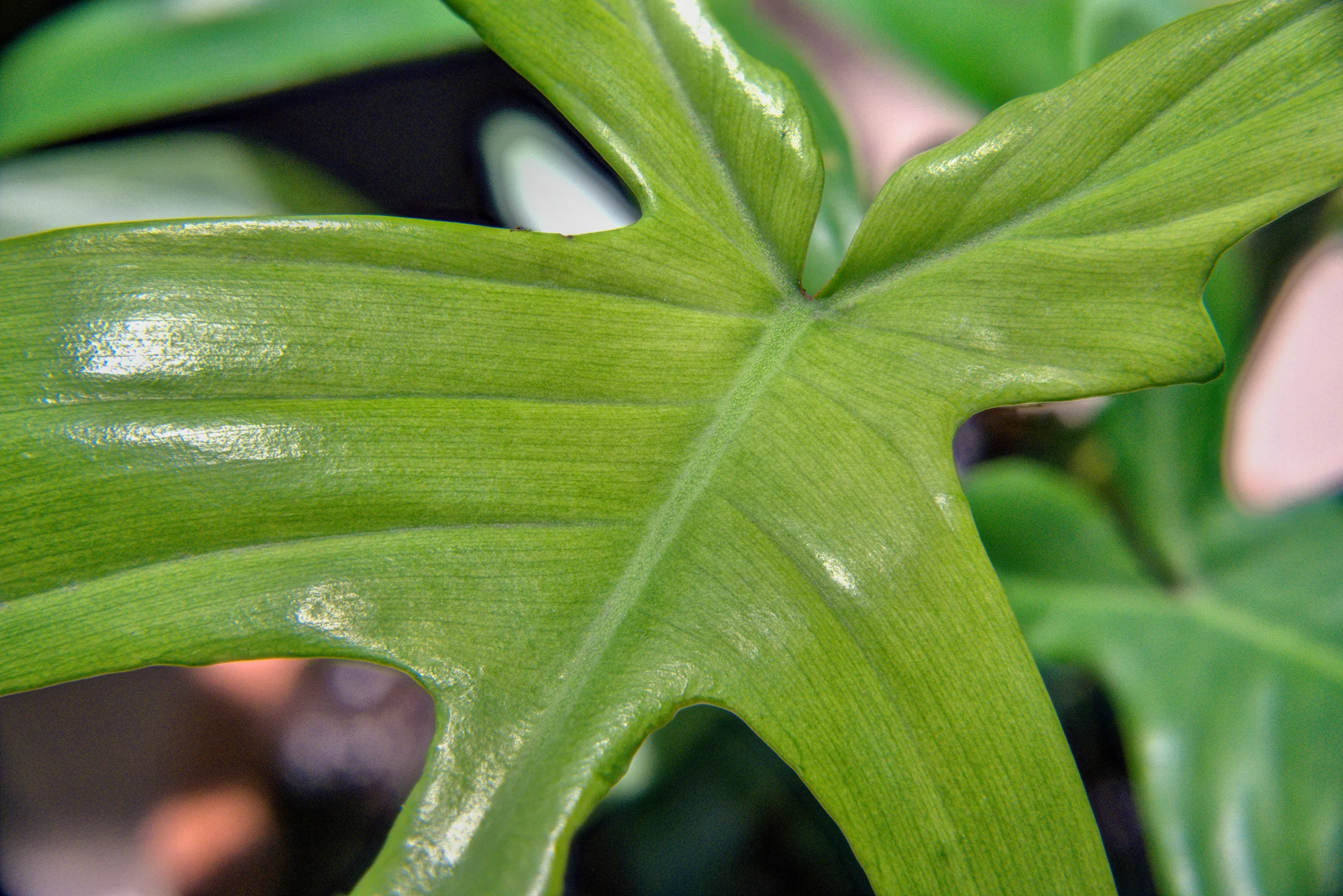
What sets this one apart is the new growth. A leaf unfurls creamy white — the ghost — and greens over the following weeks as its chloroplastschloroplastThe compartment inside a plant cell that does photosynthesis. White leaf tissue has none that work, which is why it cannot pay its own way.Glossary mature and chlorophyll fills in; in brighter light the leaves come out paler and stay pale longer.78 It is not variegationvariegationPatches of leaf with little or no chlorophyll, so they read as white, cream or yellow. The pale tissue cannot feed itself, which is why a variegated plant grows more slowly than a plain one.Glossary and it does not persist. A plant with several pale leaves at once is a plant growing quickly, not a plant with a stable pattern: ‘Florida Beauty’ has chimeralchimeraA plant built from cell layers of different genetics, one carrying a mutation and one not. Most stable variegation is a chimera, which is why it cannot be grown from seed.Glossary variegationvariegationPatches of leaf with little or no chlorophyll, so they read as white, cream or yellow. The pale tissue cannot feed itself, which is why a variegated plant grows more slowly than a plain one.Glossary that stays; the ghost is a phase.
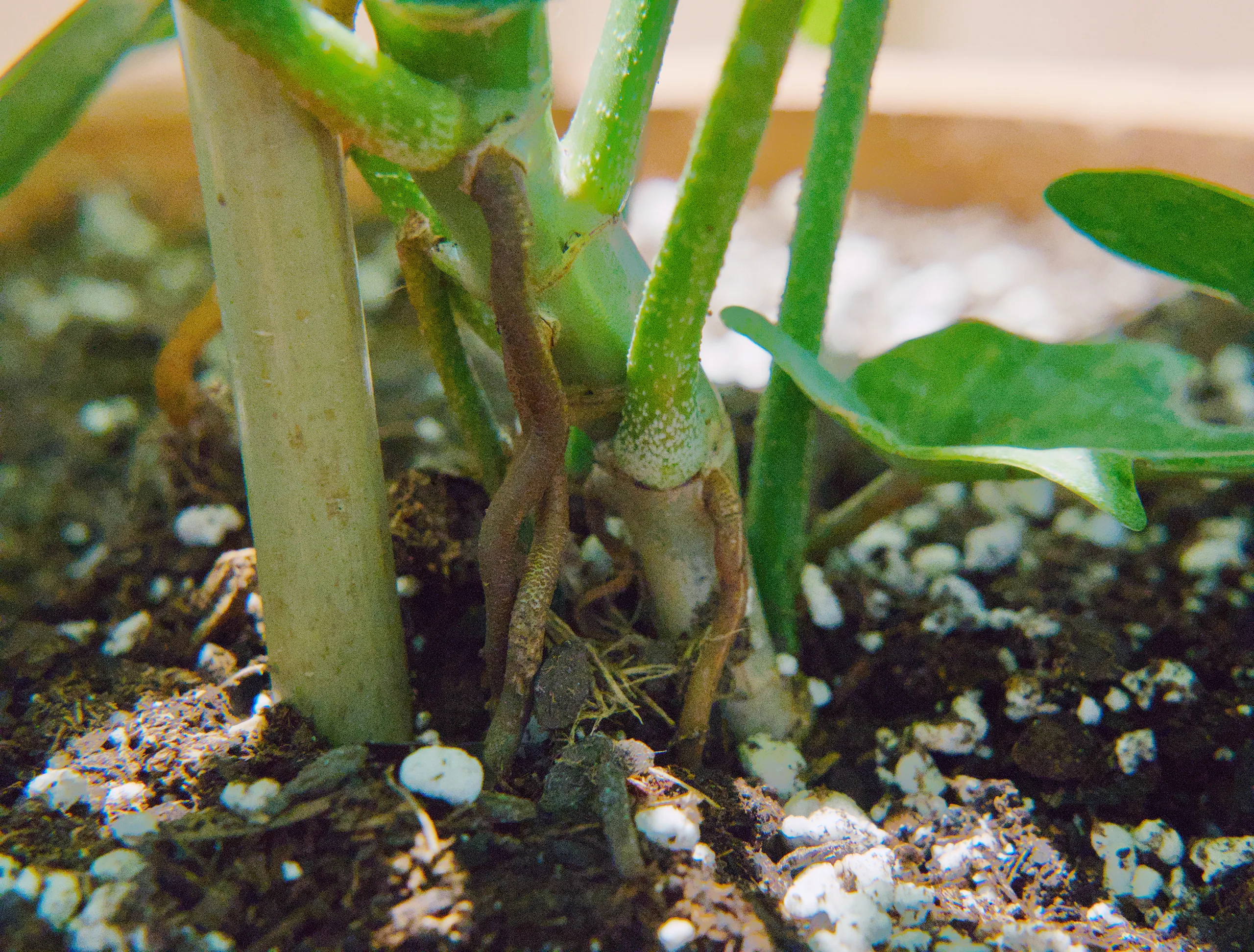
The petiolespetioleThe stalk that carries a leaf. Length, colour and texture often tell species apart when the leaves do not.Glossary carry a faint roughness from the squamiferum side, where the petiolespetioleThe stalk that carries a leaf. Length, colour and texture often tell species apart when the leaves do not.Glossary are covered in small spreading scales that read as bristles.9 Here it is far less pronounced.
Fun facts
- The white is temporary, and that is the whole plant. Every ‘Florida Ghost’ leaf ends up green. What varies between plants is how long the pale phase lasts and how many leaves are in it at once, and both follow light and growth rate rather than anything about the plant’s quality.7
- It is slower than its parents. New leaves with little chlorophyll cannot pull their weight while they are pale, so the cultivarcultivarA plant selected and propagated by people rather than described from the wild. Written in single quotes after the species — Monstera deliciosa 'Thai Constellation' — and never italicised.Glossary grows more slowly than either species behind it7 — do not expect hybrid vigourhybrid vigourThe tendency of a cross to outgrow both its parents. Not a rule — plenty of hybrids, including some here, grow more slowly than either.Glossary. Mature leaves still reach thirty centimetres.
- The lobes arrive with maturity. Juvenile leaves are far simpler than the five-lobed shape the plant is sold on, so a young one looks like a different and much duller plant. Give it something to climb; that is the general rule for climbing philodendrons rather than a measured fact about this one.
Care
Plant care- Light
- Bright indirect, and genuinely tolerant of medium light: they hold on at very low levels, but leaf size and colour need a few times more than that. The velvet-leaved species burn in direct sun more readily than the glossy climbers do.
- Water
- Keep evenly moist without being wet. Water when the top 2-3 cm has dried; the thinner-leaved species wilt visibly and recover quickly, which makes them easy to read.
- Humidity
- 50% is enough for most. The velvet-leaved species want 60-70% and show it immediately when they do not get it.
- Temperature
- 64-81 °F (18-27 °C). Growth stops around 59 °F (15 °C), and chilling damage starts below about 50 °F (10 °C) without any frost.
- Substrate
- Airy and bark-heavy for climbers; a slightly finer mix with more coir for the crawlers, which root along the surface rather than down.
- Fertilizer
- A balanced feed at half strength every third watering in growth. Velvet-leaved species are sensitive to over-feeding — the leaf edges go first.
- Propagation
- Node cuttings for climbers; for crawlers, cut the rhizome between leaves leaving at least one node and one root per piece.
- Dormancy
- None, but growth slows in winter. Reduce water and stop feeding.
- Common problems
-
- Yellow leaves with brown wet spots are overwatering; yellow with crisp edges is dry air or underwatering
- Velvet-leaved species mark if water sits on the leaves
- Long gaps between leaves and small leaf size mean the plant wants more light or something to climb
- Thrips are the usual culprit behind stippled, silvery new growth
- Yellow lesions in a mosaic pattern are a virus: no cure, isolate or discard
- Every part carries calcium oxalate crystals: the sap irritates skin, and a chewed leaf burns the mouth. Poison-centre records show it is rarely worse than that, but keep it away from pets and children anyway
These photographs also live in the gallery .