Monstera deliciosa 'Thai Constellation'
Thai Constellation
- Family
- Araceae
- Native to
- Mexico to tropical America, including the Lesser Antilles
- Habit
- Hemiepiphytic climber
My plant
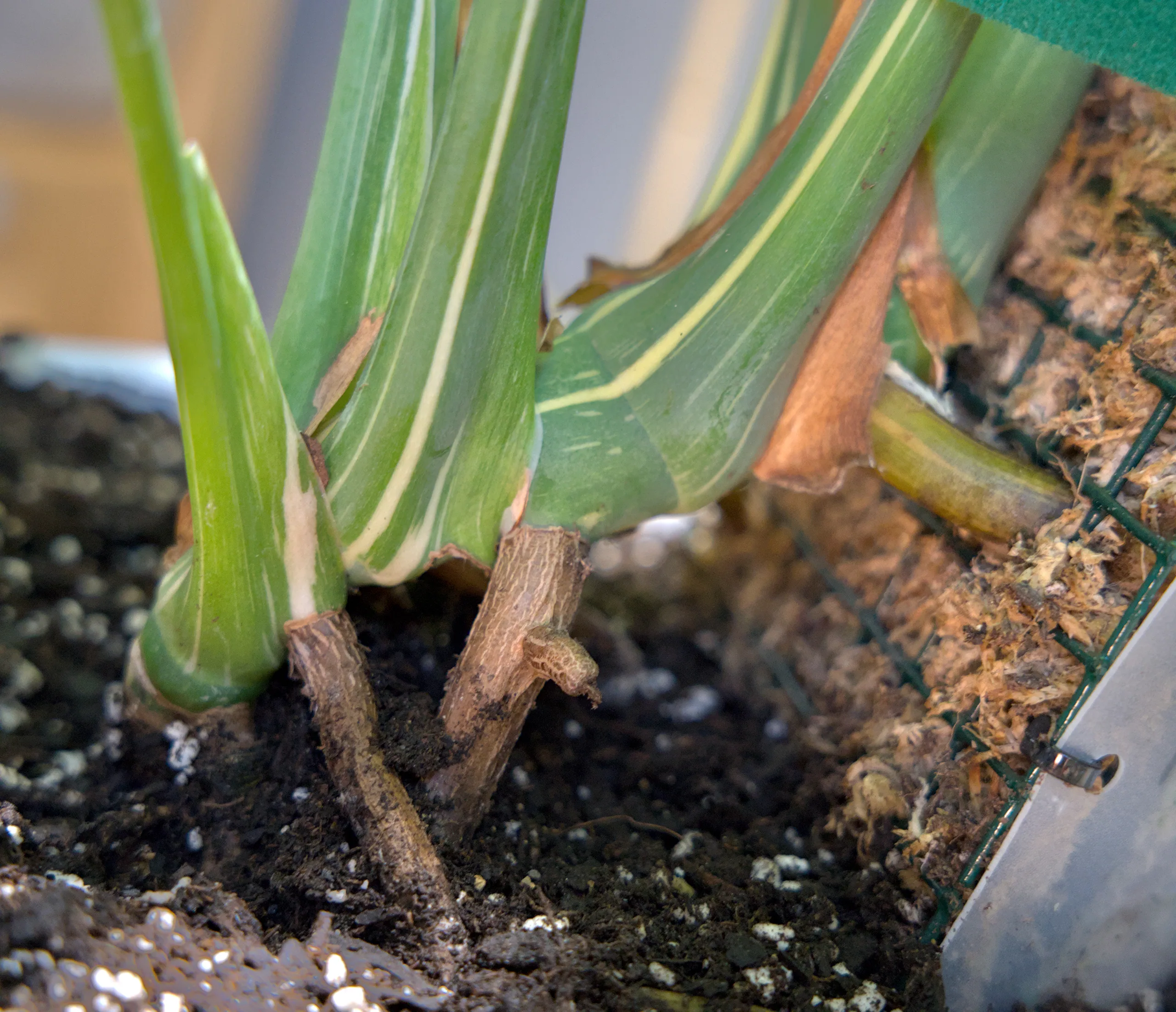
Where it comes from
Like the Monstera albo, this is a variegatedvariegationPatches of leaf with little or no chlorophyll, so they read as white, cream or yellow. The pale tissue cannot feed itself, which is why a variegated plant grows more slowly than a plain one.Glossary form of Monstera deliciosa rather than a plant with a range of its own. The species is native to southern Mexico and Guatemala;1 the cultivarcultivarA plant selected and propagated by people rather than described from the wild. Written in single quotes after the species — Monstera deliciosa 'Thai Constellation' — and never italicised.Glossary did not arise anywhere in that range.
Beyond that, the origin is undocumented, and the two accounts in circulation contradict each other. One says it was first found in a tissue-culturetissue cultureGrowing plants from a few cells in sterile jars of nutrient gel. It is how a rare cultivar becomes a supermarket plant, and why prices for some of them collapse.Glossary lab in Thailand;2 a grower who has worked with it for years says it was found growing by a Thai roadside in the 1970s and only put into tissue culturetissue cultureGrowing plants from a few cells in sterile jars of nutrient gel. It is how a rare cultivar becomes a supermarket plant, and why prices for some of them collapse.Glossary in the mid-2000s — multiplied in a lab, not made in one.3 No patent, catalogue or paper settles it: Costa Farms says it cannot be patented because it was already on the market,4 and its first trade-press milestone is being voted favourite new foliage plant at the Tropical Plant International Expo in January 2020.5 What is not in dispute is that it reaches growers through tissue culturetissue cultureGrowing plants from a few cells in sterile jars of nutrient gel. It is how a rare cultivar becomes a supermarket plant, and why prices for some of them collapse.Glossary, which is the whole reason it exists in quantity.
Naming and description
‘Thai Constellation’ is a cultivarcultivarA plant selected and propagated by people rather than described from the wild. Written in single quotes after the species — Monstera deliciosa 'Thai Constellation' — and never italicised.Glossary name — single quotes after the species, not italics — the convention for something selected and propagated by people rather than described from the wild.6
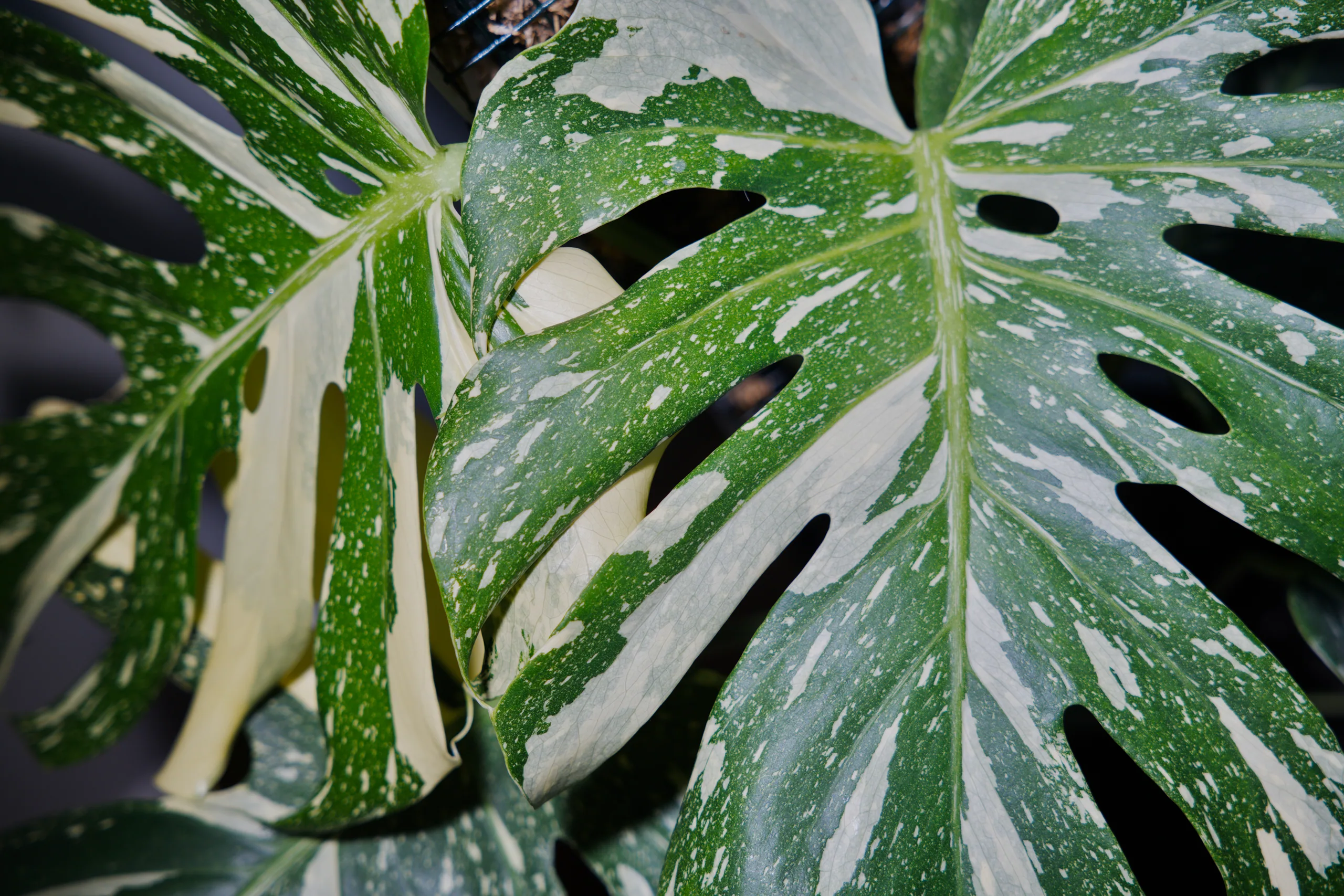
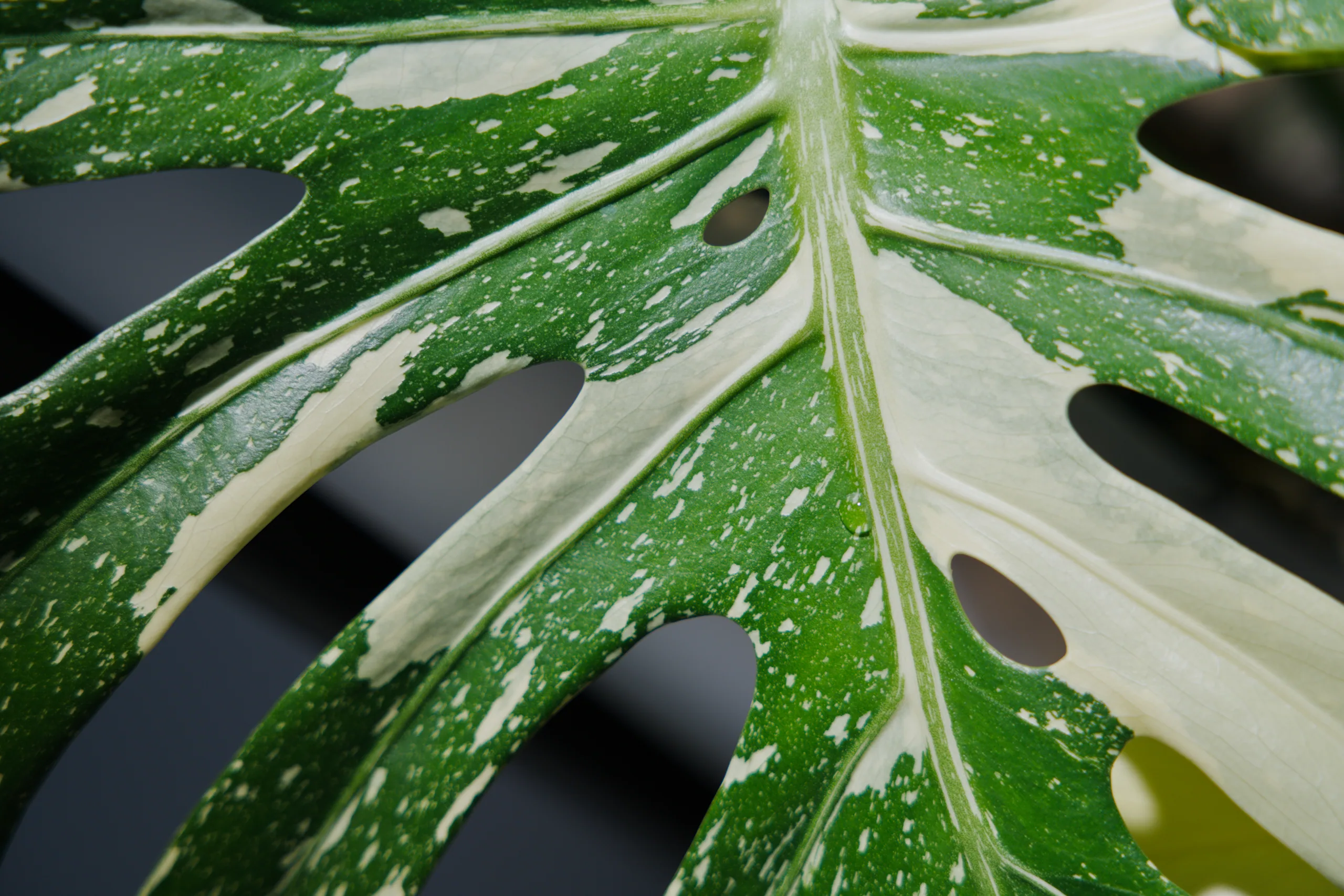
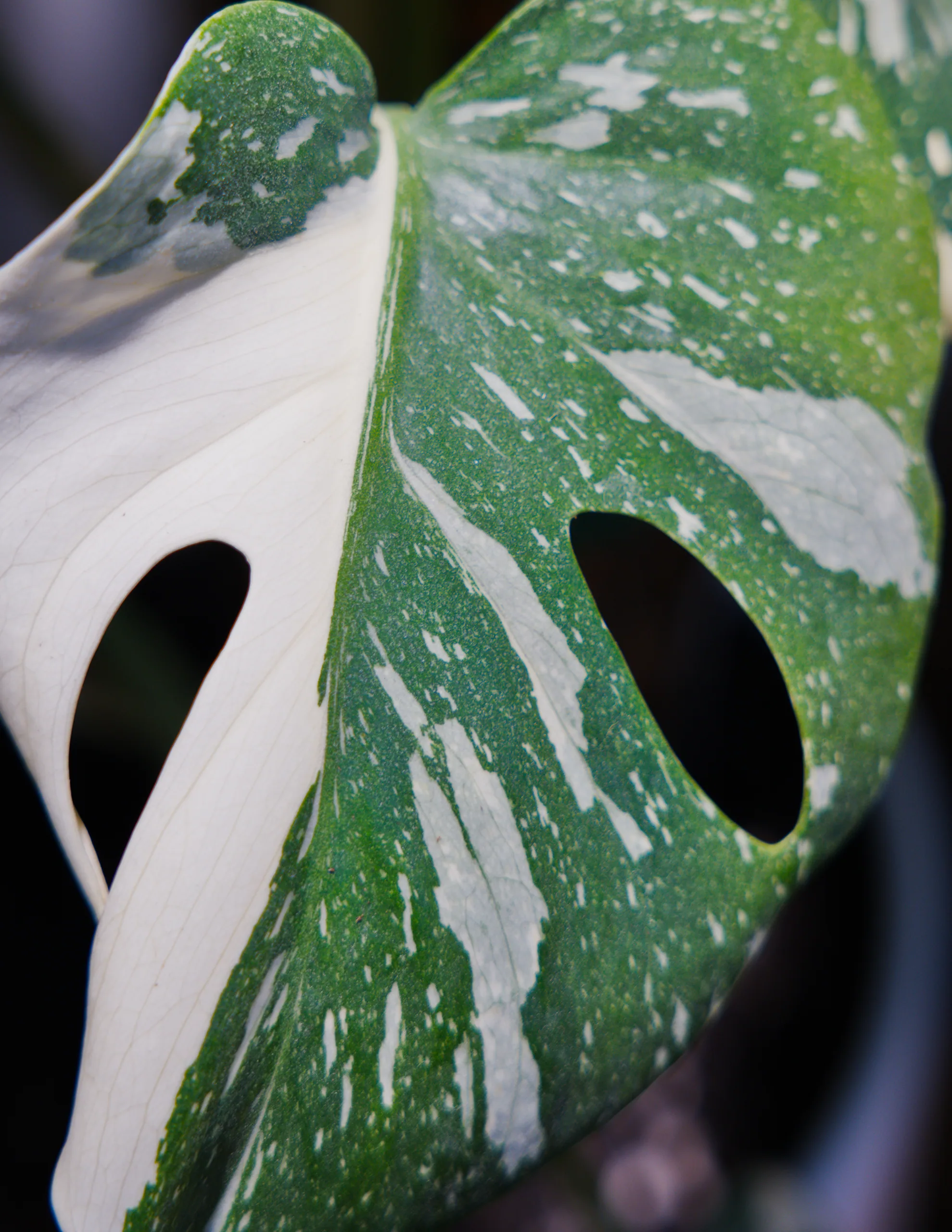
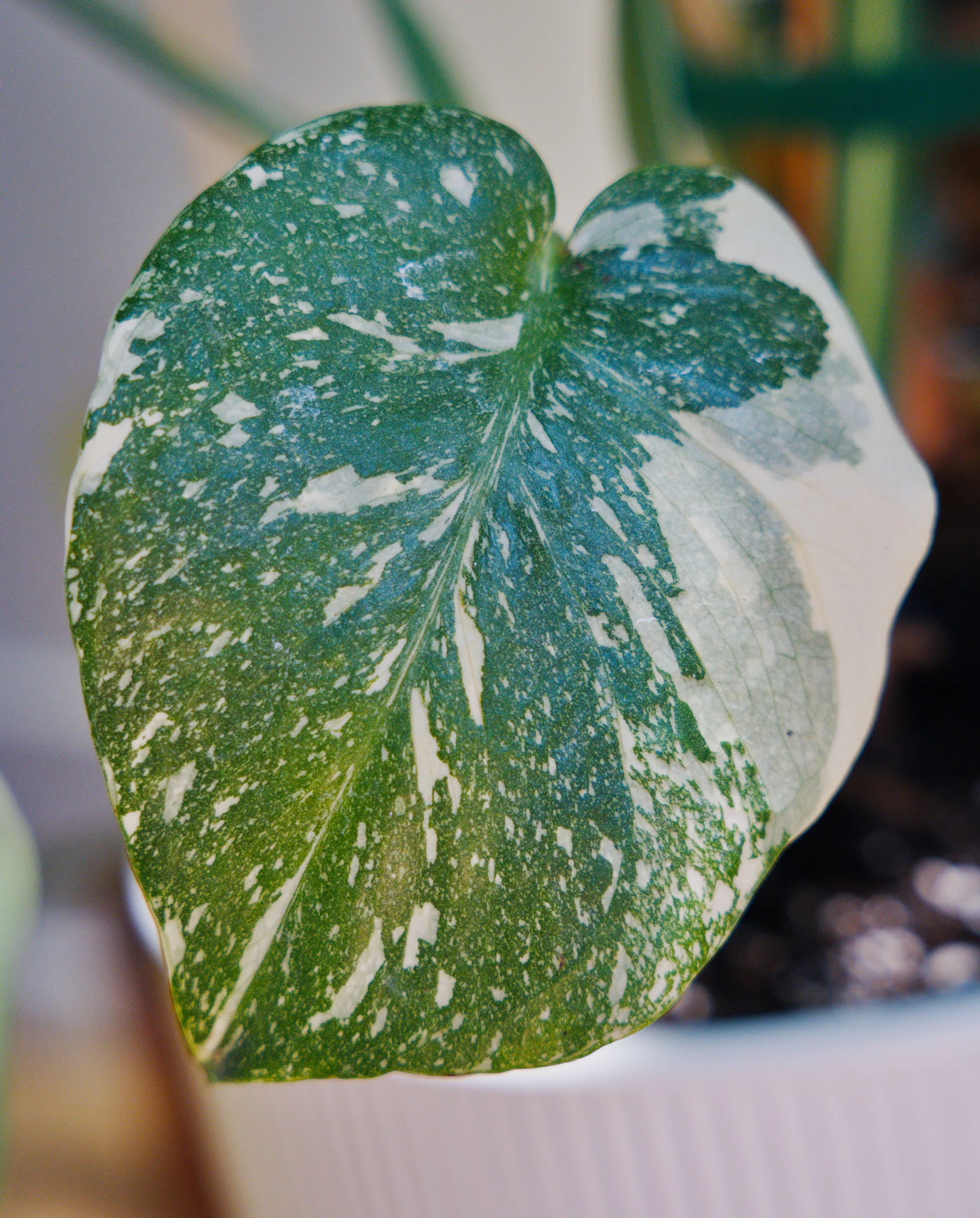
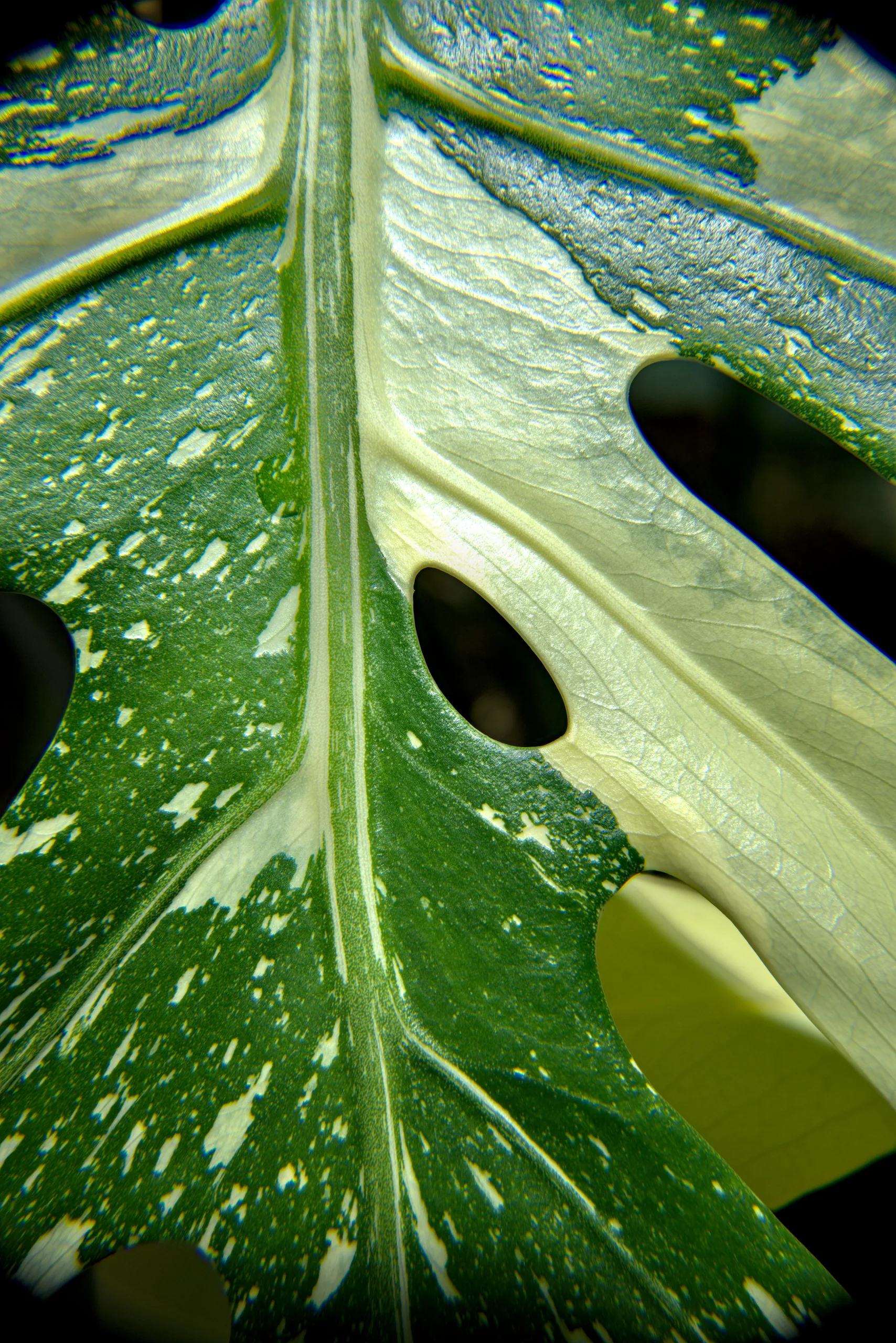
The name is a fair description. The variegationvariegationPatches of leaf with little or no chlorophyll, so they read as white, cream or yellow. The pale tissue cannot feed itself, which is why a variegated plant grows more slowly than a plain one.Glossary comes as cream to pale-yellow flecks scattered across the leaf, dense in places and sparse in others, rather than the clean white blocks the albo produces. Two Thai Constellations look far more alike than two albos do, though heavily multiplied lines drift, and a few recognisable sub-forms circulate under their own trade names.3
The practical difference between the two is stability, and here the story is more interesting than the label. Growers and the two published propagation papers call the pattern stable through tissue culturetissue cultureGrowing plants from a few cells in sterile jars of nutrient gel. It is how a rare cultivar becomes a supermarket plant, and why prices for some of them collapse.Glossary,47 and that is why it can be mass-produced at all. But when Costa Farms tried to produce it by the tens of thousands, it announced in 2022 that “quirks” in tissue culturetissue cultureGrowing plants from a few cells in sterile jars of nutrient gel. It is how a rare cultivar becomes a supermarket plant, and why prices for some of them collapse.Glossary had stalled the launch indefinitely,8 and a Clemson researcher describes scaling it up as a matter of “losing the white”.2 Stable enough to mass-produce, then, with effort; not simply stable. Nobody has published the genetics of the variegationvariegationPatches of leaf with little or no chlorophyll, so they read as white, cream or yellow. The pale tissue cannot feed itself, which is why a variegated plant grows more slowly than a plain one.Glossary — the two papers that exist are about how to culture it, not why it holds7 — so treat the mechanism as reported.
Fun facts
- The price collapse is the interesting fact about it. A cultivarcultivarA plant selected and propagated by people rather than described from the wild. Written in single quotes after the species — Monstera deliciosa 'Thai Constellation' — and never italicised.Glossary that cannot be tissue-culturedtissue cultureGrowing plants from a few cells in sterile jars of nutrient gel. It is how a rare cultivar becomes a supermarket plant, and why prices for some of them collapse.Glossary stays rare however many people want it, because supply is limited by how fast someone can take cuttings. One that can be is limited only by lab capacity. This plant went from three or four figures to a supermarket price in a few years; the albo, the same species with the same appeal, did not.3
- Cream is not white, and it is not free either. Pale sectorssectorA block of tissue descended from one group of cells — the whole-half-leaf kind of variegation, as opposed to an even speckling.Glossary carry less chlorophyll than green ones rather than none — shown in a related aroid, golden pothos9 — so the plant is still doing more with less leaf, just more evenly, and rarely to the extreme a half-white albo leaf reaches. It grows more slowly than the plain species for the same reason.4
- It fenestratesfenestrationThe holes and splits in a mature Monstera leaf. They are cut by cells dying on schedule inside the furled bud, not torn later, so a leaf never gains one after it opens.Glossary on the same schedule as the plain species. The holes and splits follow maturity and light, not the variegationvariegationPatches of leaf with little or no chlorophyll, so they read as white, cream or yellow. The pale tissue cannot feed itself, which is why a variegated plant grows more slowly than a plain one.Glossary, so a young one looks like any other young deliciosa with freckles. The RHSRHSThe Royal Horticultural Society. Its plant register and its Award of Garden Merit are among the few horticultural authorities worth citing.Glossary puts it under glass year-round with a minimum of 50–59 °F (10–15 °C).10
Care
Plant care- Light
- Bright indirect. An east window, or a few feet back from a south or west one. Direct midday sun scorches the leaves; deep shade produces long internodes, small leaves and no fenestration.
- Water
- Water thoroughly once the top 2-5 cm of mix has dried, then let it drain completely. They tolerate a short dry spell far better than they tolerate sitting wet.
- Humidity
- Moderate to high. Numbers are hard to source; what is documented is that dry air browns the leaf edges. The link people draw between low humidity and fewer fenestrations is not — light is what decides that.
- Temperature
- 64-84 °F (18-29 °C). Growth stops around 50 °F (10 °C), and chilling damage — wilting, water-soaked patches — starts below about 50 °F (10 °C) without any frost. Keep them off cold glass and out of winter draughts.
- Substrate
- Chunky and free-draining — roughly equal parts orchid bark, perlite and coir. Straight potting compost holds too much water against the roots.
- Fertilizer
- A balanced feed at half strength every second or third watering through spring and summer. Little or none through winter.
- Propagation
- Stem cuttings with at least one node, ideally with an aerial root attached. Roots readily in water, sphagnum or straight into a chunky mix.
- Dormancy
- No true dormancy, but growth slows markedly in low light and cool temperatures. Cut back watering to match.
- Common problems
-
- Yellowing lower leaves are usually too much water or too little light, and rarely too little water
- Crisp brown edges point at dry air, or salts accumulated from feeding
- New leaves opening without fenestration usually means not enough light
- Spider mites and thrips establish quickly in dry air — check the undersides
- Every part carries calcium oxalate crystals: toxic to cats, dogs and children if chewed, and the sap can irritate skin
These photographs also live in the gallery .